


Google and AI engines now rank and cite the sources they can *trust* — and trust is something you have to prove on the page, not claim. E-E-A-T (Experience, Expertise, Authoritativeness, Trustworthiness) is the framework both Google's human quality raters and its AI systems use to separate genuinely helpful content from confident-sounding filler. In 2026 it is no longer a "your money or your life" niche concern: Google's December 2025 quality update extended the same high expectations to virtually every competitive query.
If your content reads like it was written by someone who has never done the thing they're describing, it will quietly lose ground — in classic search and in ChatGPT, Gemini, and AI Overviews alike. This guide explains what each letter means with the new emphasis on first-hand experience, how E-E-A-T shows up on and off the page, and a practical checklist to raise yours.
What E-E-A-T Actually Is (and Isn't)
E-E-A-T is not a ranking factor you can toggle. There is no "E-E-A-T score" in Google's algorithm. It is a *concept* described in Google's Search Quality Rater Guidelines — the 170-plus-page manual the human evaluators use to judge whether search results are helpful. Those ratings train and calibrate the ranking systems, so E-E-A-T shapes rankings indirectly but powerfully.
The extra "E" — Experience — was added to the original E-A-T in late 2022, and by 2026 it has become the differentiator. Anyone can now generate expert-sounding prose in seconds. What a language model *cannot* fake is having actually stayed at the hotel, run the software, treated the patient, or rebuilt the engine. First-hand experience is the signal that survives the AI-content flood.
Think of E-E-A-T as the answer to one question a skeptical reader — or a machine acting on their behalf — asks about your page: "Why should I believe this, from you?"
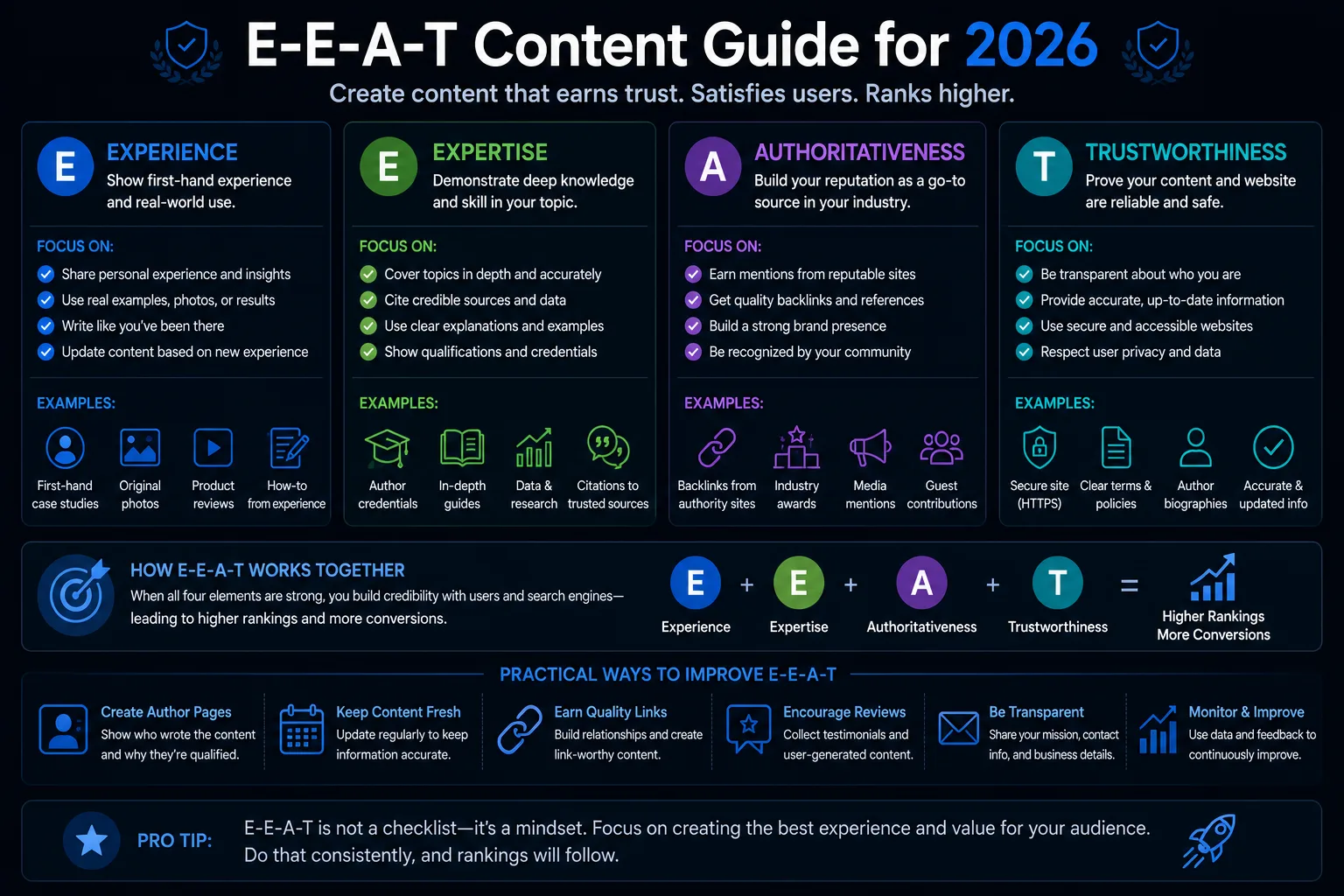
The Four Pillars, Decoded
Google is explicit that Trust is the most important member of the family — the other three feed into it. Here is what each pillar means in practice.
Experience — the 2026 differentiator
Does the creator have first-hand, real-world experience with the topic? A review written by someone who actually used the product, a travel guide by someone who made the trip, a tax explainer by a practising accountant. Show it: original photos, specific details only a user would know, "we tested," "in our 40 projects," before-and-after results. This is where most thin content and AI spam fails instantly.
Expertise — depth of knowledge
Does the creator have the knowledge or skill for the topic? Expertise is demonstrated through accurate, thorough, up-to-date content and visible credentials where relevant. For a medical page, formal qualifications matter; for a hobby, deep hands-on knowledge counts as "everyday expertise."
Authoritativeness — reputation as a go-to source
Is the creator or website a recognised authority on the subject? Authority is largely earned *off* your site: citations, mentions, and links from other reputable sources that treat you as a reference. You claim expertise; the wider web confers authority.
Trustworthiness — the foundation
Is the page accurate, honest, safe, and reliable? Trust covers secure transactions, transparent contact and ownership details, honest claims, correct information, and clear sourcing. A page can be experienced and expert yet still fail on trust — and Google says untrustworthy pages have low E-E-A-T no matter how the other pillars score.
Why the December 2025 Update Raised the Stakes
Historically, strict E-E-A-T scrutiny was reserved for YMYL ("Your Money or Your Life") topics — health, finance, legal, safety. Google's December 2025 quality update effectively extended those elevated expectations to all competitive queries. As AI-generated content saturated every niche, Google needed a way to keep surfacing content backed by real people and real experience, so the trust bar rose across the board.
The practical takeaway: you can no longer assume that "it's just a product roundup" or "it's only a how-to" exempts you from proving credibility. If a query is competitive, the pages that win now visibly demonstrate who made the content and why they're qualified. Strong SEO fundamentals still matter, but they no longer compensate for a missing byline and zero first-hand signal.
This is also why the update rewarded sites that had quietly built trust over years and punished those that scaled content fast. If you saw traffic slip after December without an obvious technical cause, the culprit is usually an experience and credibility gap — pages that answer the query adequately but give a reader no reason to believe *this* source over a dozen identical ones.
How E-E-A-T Shows Up On-Page
E-E-A-T is abstract until you translate it into elements a reader and a crawler can actually see. These are the on-page signals that make trust legible.
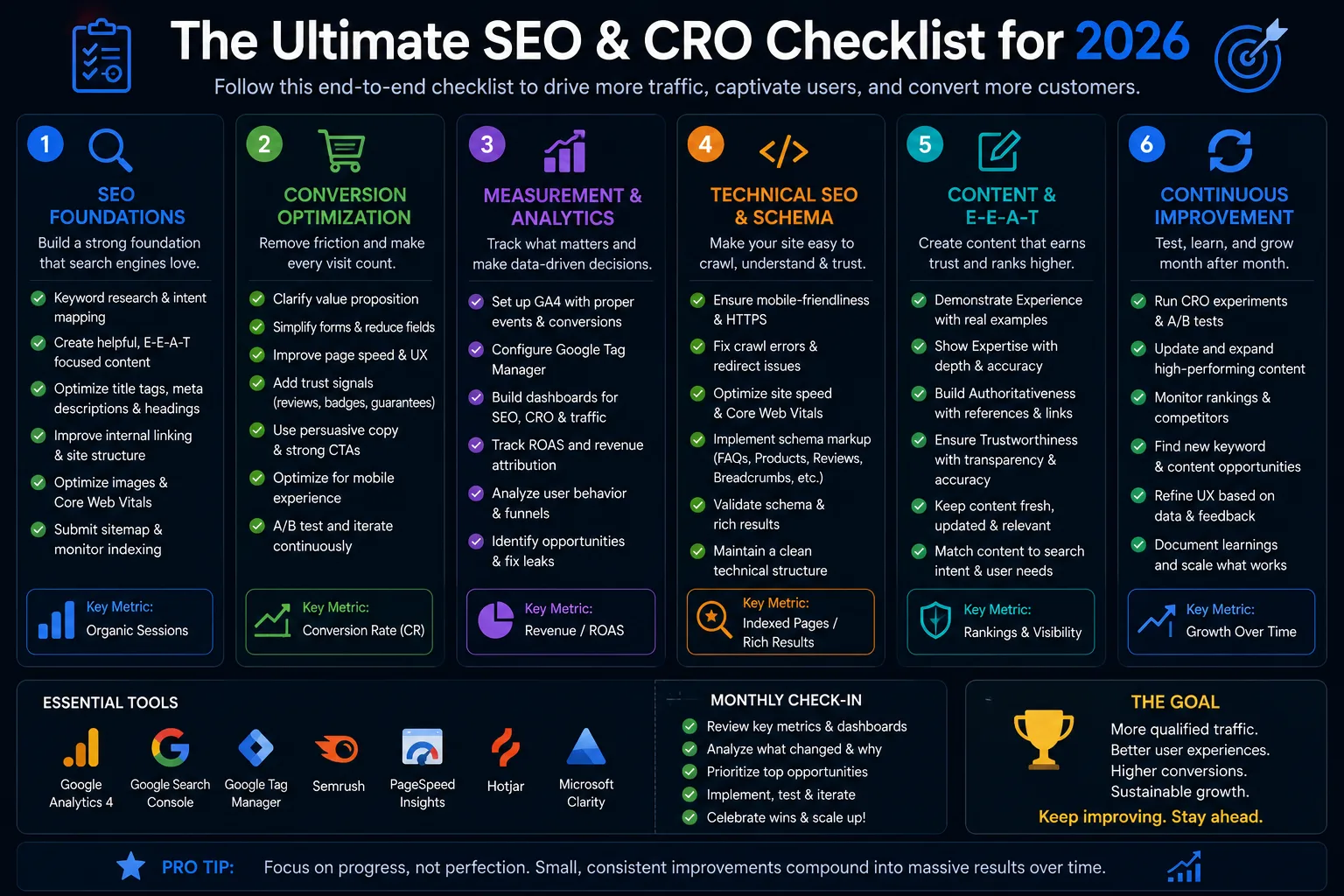
- Real author bios and bylines. Name a human author, link to a detailed bio page, and state their relevant experience. "Written by our team" is a weak signal; a named expert with a track record is a strong one.
- Visible credentials. Where they matter (health, finance, law), show qualifications, licences, or role. For everyday topics, show the hands-on experience instead.
- Citations to primary sources. Link claims to original research, official documentation, or data — not to other people's summaries. Sourcing is a core trust signal.
- Original data and first-hand detail. Your own tests, case studies, screenshots, photos, and numbers are the hardest thing for competitors and AI to replicate. This is your E-E-A-T moat. Building this into your content writing is the highest-leverage move you can make.
- Clear, honest "last updated" dates. Show when content was published and genuinely refreshed. Freshness signals reliability — but only if the update is real, not a date bump.
- Transparent site trust markers. Easy-to-find contact info, an About page, an ownership/editorial policy, HTTPS, and honest claims with no exaggeration.
Getting these right is core on-page SEO work: the content structure and metadata that let both people and machines see who stands behind the page.
Off-Page Trust: Reviews, Mentions, and Links
Authoritativeness is a reputation signal, and reputation lives beyond your domain. Google's raters are told to research a site's reputation using independent sources — so what the rest of the web says about you feeds directly into E-E-A-T.
- Reviews. Volume, recency, and sentiment on Google, industry platforms, and marketplaces signal real-world trust. A steady flow of specific, recent reviews beats a stack of old five-stars.
- Unlinked mentions. Being named in press, roundups, forums, and communities — even without a link — tells search and AI systems you exist and matter beyond your own marketing.
- Backlinks from reputable sites. Editorial links from sources that are themselves trusted remain one of the strongest authority signals. Quality and relevance beat volume every time.
Earning these is the long game of content marketing: publish things worth citing, and the mentions, links, and reputation compound over time.
E-E-A-T for YMYL Topics
If your content can affect someone's health, financial stability, safety, or major life decisions, it is YMYL — and the E-E-A-T bar is at its highest. A wrong answer here can cause real harm, so Google demands stronger proof of qualifications and accuracy.
For YMYL pages: put a genuinely qualified author (or expert reviewer) on the byline, cite authoritative primary sources, keep information current, and be scrupulously accurate. "Medically reviewed by Dr. [Name]" or "reviewed by a licensed [professional]" is not decoration — for these topics it is often the difference between ranking and being filtered out.
How Thin and AI-Spam Content Gets Hurt
Google's spam policies target scaled content abuse — mass-produced pages, whether written by humans or AI, created primarily to game rankings rather than help people. The problem was never AI itself; Google's position is that content is judged on quality and helpfulness regardless of how it's produced. Unedited AI output tends to fail because it has no experience, no original data, and no accountable author — the exact things E-E-A-T rewards.
Typical casualties: pages that restate what everyone already says, "ultimate guides" with no first-hand insight, review pages by someone who never touched the product, and AI drafts published without expert editing. Using AI as a drafting tool is fine — but a human with real experience must add the judgement, examples, and fact-checking that make it trustworthy. If you use AI in your workflow, our approach to AI SEO keeps quality and E-E-A-T intact.
Why E-E-A-T Now Drives AI Citations Too
The same trust signals that lift you in classic search increasingly decide whether ChatGPT, Gemini, Perplexity, and Google's AI Overviews cite you. Generative engines synthesise answers from sources they judge reliable, and they lean on the very markers E-E-A-T describes: clear authorship, consistent reputation across the web, original data, and citable, well-sourced passages.
In practical terms, an answer-first page with a named expert, primary-source citations, and original numbers is both a strong search result *and* an easy thing for an AI to quote confidently. E-E-A-T is now the shared currency of search rankings and AI citations. For the mechanics of getting named in AI answers, see our guide on how to get found on ChatGPT and AI Overviews, and for the wider picture, our 2026 SEO guide.
Your Practical E-E-A-T Checklist
Work through this to raise the trust your content demonstrates:
1. Add real bylines and bios. Every meaningful page gets a named author linked to a credential-rich bio. 2. Inject first-hand experience. Add original photos, tests, case studies, and "we did this" specifics that only real experience produces. 3. Cite primary sources. Link claims to original research and official docs, not second-hand summaries. 4. Publish original data. Even a small survey, benchmark, or before/after result gives you something no one can copy. 5. Show honest dates. Display publish and genuine last-updated dates; refresh content on a real schedule. 6. Harden trust markers. Complete About and Contact pages, editorial or ownership policy, HTTPS, and no exaggerated claims. 7. Build off-page reputation. Earn reviews, mentions, and quality backlinks through genuinely citable work. 8. Add an expert review layer for YMYL. Have a qualified professional review sensitive content before it publishes.
Turning Trust Into Traffic
E-E-A-T rewards the businesses that actually know their field and are willing to show it. You cannot shortcut it with more words — you raise it by putting real people, real experience, and real evidence on the page, then earning a reputation that the rest of the web confirms. That is exactly what makes content rank in Google and get cited by AI in 2026.
If you'd like a second set of eyes on where your content is losing trust — and a plan to fix it — request a free estimate. We'll audit your author signals, sourcing, and reputation, and map the highest-impact E-E-A-T wins for your site.