


Conversion rate optimization (CRO) is the practice of increasing the share of your visitors who take the action you want — buying, booking, calling, or filling in a form — without spending a cent more on traffic. In 2026, with ad costs climbing and every click harder to earn, CRO is often the highest-return work a business can do: you already paid for the visitors, so turning more of them into customers is close to free growth.
This guide explains how CRO actually works, the simple math that makes it so powerful, a process you can run without a data-science team, and the handful of places where the biggest wins almost always hide.
What Conversion Rate Optimization Actually Is
Your conversion rate is simply the percentage of visitors who complete a goal. If 1,000 people visit your landing page in a week and 20 request a quote, that page converts at 2%. CRO is the disciplined work of moving that number up — by removing friction, sharpening your message, and making the next step obvious.
It is not about tricks or dark patterns. Sustainable CRO makes your site clearer and more trustworthy, which happens to be exactly what both your customers and Google reward. Done well, it compounds with every other channel: better conversion makes your paid traffic cheaper per customer, your SEO traffic more valuable, and your email campaigns more profitable.
The Math: Why a Small Lift Changes Everything
CRO feels abstract until you put money on it. Imagine a business getting 5,000 visitors a month, converting at 2%, with an average customer worth €400.
- Today: 5,000 × 2% = 100 customers = €40,000/month
- Lift the rate to 3%: 5,000 × 3% = 150 customers = €60,000/month
That single percentage point is €20,000 a month — €240,000 a year — from the same traffic and the same ad budget. Now compare that to the cost and effort of increasing traffic by 50% to get the same result. This is why experienced marketers treat conversion rate as a growth lever, not a vanity stat. The same logic runs in reverse for slow, confusing pages: every point of friction quietly taxes revenue you have already paid to earn.
The CRO Process: Measure, Hypothesize, Test, Iterate
CRO is a loop, not a one-time redesign. Guessing at changes and shipping them is how teams fool themselves. A disciplined cycle looks like this:
1. Measure. Establish your baseline in analytics and reporting. Which pages get traffic but few conversions? Where do people drop out of your funnel? You cannot improve what you have not quantified. 2. Hypothesize. Form a specific, testable statement: "Adding pricing to the service page will increase quote requests, because visitors currently leave to look for cost information." A good hypothesis names the change, the expected effect, and the reason. 3. Test. Run the change as a controlled experiment — ideally an A/B test — so you know the result came from your change and not from luck or seasonality. 4. Iterate. Keep the winners, learn from the losers, and feed what you learned into the next hypothesis. Over months, these small, verified gains stack into a dramatically better site.
Where the Biggest Wins Hide
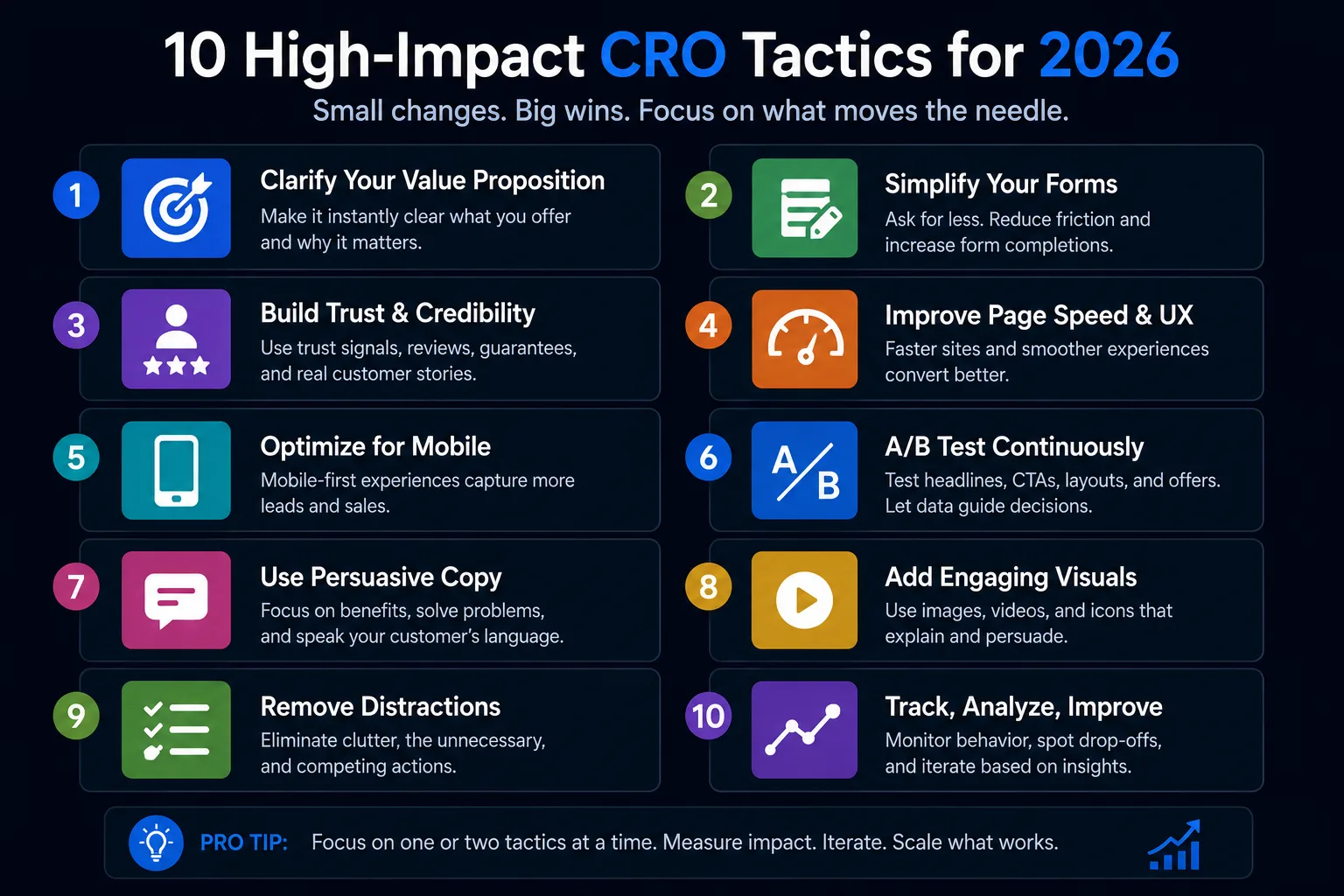
You do not need to test button colors. Real lifts come from a short list of high-leverage areas. Start here:
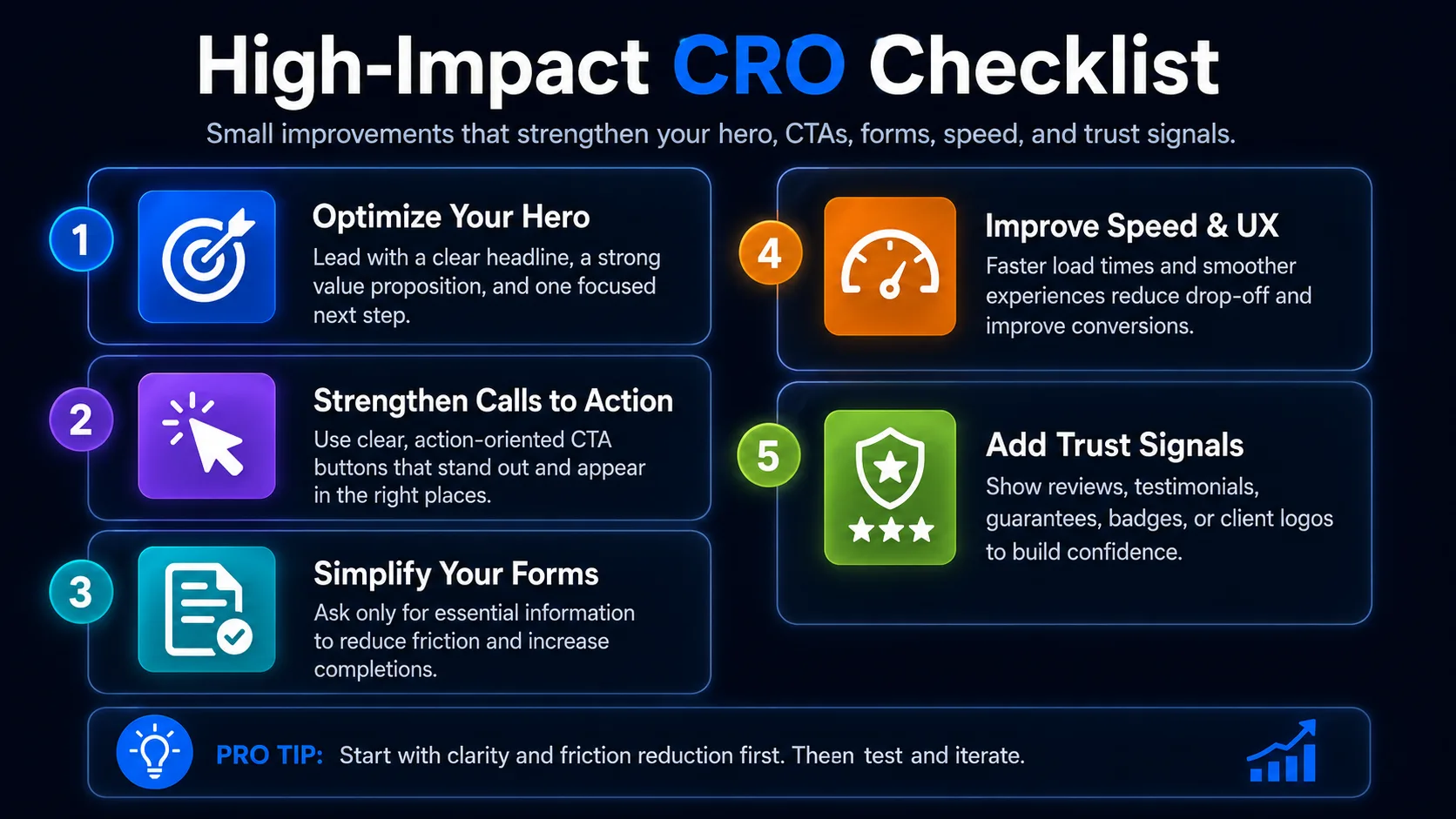
Your hero and value proposition Within seconds, a visitor should understand what you offer, who it is for, and why you over the alternatives. Vague headlines like "Welcome to our website" waste your most valuable pixels. Lead with a concrete benefit and a clear next step.
Calls to action Every page needs one obvious primary action. Make the button text specific — "Get my free estimate" beats "Submit" — and make sure it stands out visually. Competing calls to action split attention and lower conversions.
Forms Forms are where intent goes to die. Every extra field costs you completions. Ask only for what you truly need to take the next step; you can always gather more later. On a quote form, a name, a contact detail, and a one-line description usually beats a ten-field interrogation.
Speed and mobile experience A page that loads slowly or shifts around as it loads bleeds conversions before a visitor even reads it. This is where CRO and technical performance meet — see our guide to [Core Web Vitals and INP](/blog/core-web-vitals-inp-2026). Most of your traffic is on a phone, so test every change on a real mobile screen, not just your desktop.
Trust signals People convert when they feel safe. Reviews, testimonials, client logos, guarantees, real photos, clear contact details, and security badges all lower the perceived risk of saying yes. Put them where the decision happens — next to the form or the buy button, not buried in the footer.
A/B Testing Without Fooling Yourself
An A/B test shows version A to half your visitors and version B to the other half, then measures which converts better. It is the cleanest way to know a change actually worked — but only if you run it honestly.
- Wait for enough data. Calling a winner after 30 visitors is superstition, not science. You need a large enough sample for the result to be reliable; low-traffic pages may need weeks.
- Respect statistical significance. Aim for around 95% confidence before you trust a result. Most testing tools calculate this for you — do not stop the moment one version pulls ahead.
- Test one big idea at a time. If you change the headline, the form, and the layout at once, a win tells you nothing about *why*. Change one meaningful thing per test.
- Watch for seasonality. A test run over a holiday week may not reflect normal behavior. Run for full weeks to smooth out day-of-week effects.
If your traffic is too low for fast A/B tests, lean harder on qualitative research and best-practice fixes instead — a genuinely clearer page rarely needs a test to justify it.
Qualitative Tools: Watch Real Users
Numbers tell you *what* is happening; watching users tells you *why*. Three inexpensive tools reveal the friction your analytics only hints at:
- Heatmaps show where people click, move, and how far they scroll — exposing ignored buttons and content nobody reaches.
- Session recordings let you watch anonymized visits and see exactly where people hesitate, rage-click, or give up.
- On-site surveys and quick user tests ask visitors what stopped them, or ask five people to complete a task while thinking aloud. A single afternoon of this often surfaces problems worth thousands in recovered revenue.
CRO for Lead Generation vs E-commerce
The principles are universal, but the details differ. For a lead-generation site — an agency, clinic, or contractor — the conversion is usually a form, call, or booking, and trust plus clarity dominate. For an e-commerce store, the funnel is longer: product page, cart, checkout. Cart and checkout abandonment is where money leaks, so guest checkout, transparent shipping costs, and multiple payment options often move the needle most. Whichever you run, well-built landing pages and a fast, credible website are the foundation everything else stands on.
Common CRO Mistakes That Waste Money
- Redesigning everything at once. A full redesign that changes a hundred things makes it impossible to learn what worked — and can tank conversions overnight. If you are rebuilding, treat it as a hypothesis and measure before and after; our website redesign projects always ship with tracking in place.
- Copying competitors blindly. You cannot see their data. Their "winning" layout may be losing for them too.
- Optimizing for the wrong metric. More clicks are worthless if they do not become customers. Always tie tests back to revenue or qualified leads.
- Stopping after one win. CRO compounds. The teams that win treat it as an ongoing habit, not a one-off project.
How Long Before CRO Pays Off
CRO is not an overnight switch. On a site with healthy traffic, a focused program usually shows its first reliable wins within one to three months, then compounds from there as tests build on tests. Low-traffic sites move slower simply because experiments take longer to reach significance — but they still benefit immediately from best-practice fixes to speed, clarity, and trust. The point is consistency: a business that ships one thoughtful test a month will, within a year, look nothing like its competitors who redesigned once and walked away.
Start With One Test This Week
You do not need a big budget or a research team to begin — you need a baseline, one honest hypothesis, and the discipline to measure. Pick your most important page, find the biggest point of friction, and fix that one thing. Then do it again.
If you would rather have experts run the loop for you — from analytics setup to tested, higher-converting pages built on a fast web development foundation — request a free estimate and we will show you where your site is leaving money on the table.