


Picture a customer in your city opening ChatGPT and typing: "Who's the best [your service] near me?" In a few seconds the assistant names three businesses and explains why each is a good fit. If yours isn't one of them, you just lost a ready-to-buy customer — and it never showed up in your analytics.
This is the new shape of search in 2026. People increasingly ask ChatGPT, Google AI Overviews, Gemini, and Perplexity instead of scrolling a page of blue links, and these engines reply with a short, curated recommendation. Generative Engine Optimization (GEO) is the practice of making sure your business is the one they recommend.
This guide is a practical, step-by-step GEO playbook for local and small businesses — not theory. You'll learn how AI engines decide who to name, the exact actions that get your business cited, a realistic timeline for results, and how to measure your AI visibility. If you've already invested in SEO or AI search optimization, this is how you extend that work into the answer box.
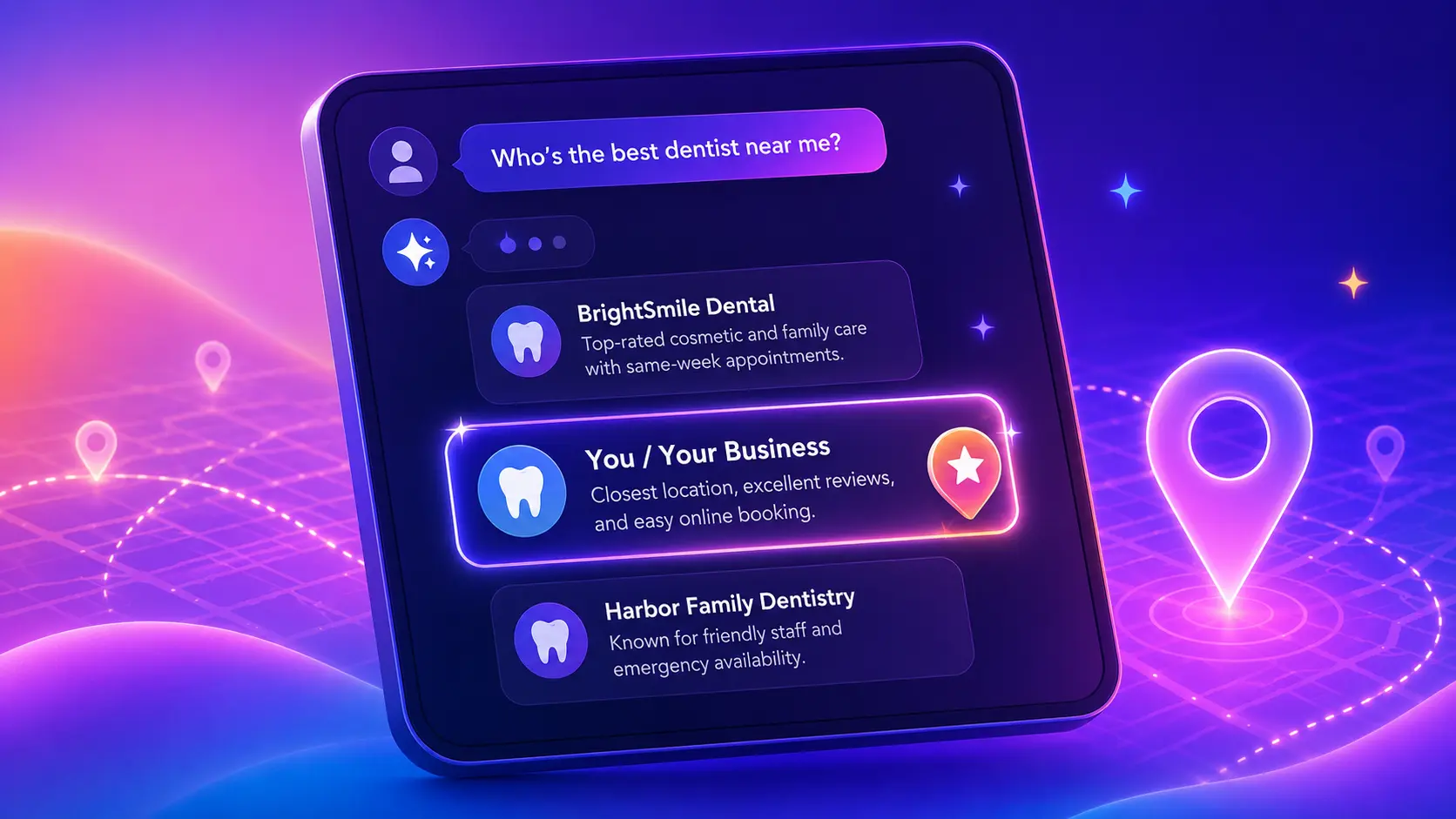
What Is Generative Engine Optimization (GEO)?
Generative Engine Optimization (GEO) is the practice of structuring your online presence so AI answer engines cite, quote, or recommend your business in the responses they generate. Where traditional SEO competes for a ranked position on a results page, GEO competes to be *part of the answer itself*.
The good news for small businesses: GEO is not a separate discipline you start from zero. Google's own 2026 guidance is blunt — optimizing for its AI features "is still SEO." GEO is an additional layer on top of solid fundamentals. The difference is emphasis: AI engines reward content that is structured, quotable, well-sourced, and consistent across the web even more aggressively than classic search does.
| Traditional SEO | GEO | |
|---|---|---|
| Goal | Rank a link on the results page | Get cited inside the AI answer |
| Unit of success | Position #1–10 | Being named or quoted |
| Click behaviour | User clicks through to your site | User may act without clicking |
| Wins on | Keywords, backlinks, on-page | Structure, authority, consistency, reviews |
| Main surfaces | Google, Bing | ChatGPT, AI Overviews, Gemini, Perplexity |
Why Local Businesses Can't Ignore AI Search in 2026
ChatGPT alone passed roughly 900 million weekly users in early 2026. Across many niches, informational organic traffic has fallen 30–70% year over year — not because Google broke, but because people now ask an assistant first. The query that used to be a Google search is now a conversation.
For local businesses the shift is even sharper. "Best plumber in [city]," "family dentist near me open Saturday," and "affordable web agency in Tirana" are exactly the conversational, intent-rich questions AI engines love to answer directly. The traditional Google Map pack still earns 44–58% of local clicks, but a growing share of buyers never reach it — they take the assistant's recommendation and call. If you serve a defined area, GEO is no longer optional; it is local visibility.
How AI Engines Decide Which Businesses to Recommend
AI engines don't crawl the live web for every answer the way Google does. They blend training data, real-time retrieval, and a handful of high-trust sources. For local recommendations, five signals do most of the work:
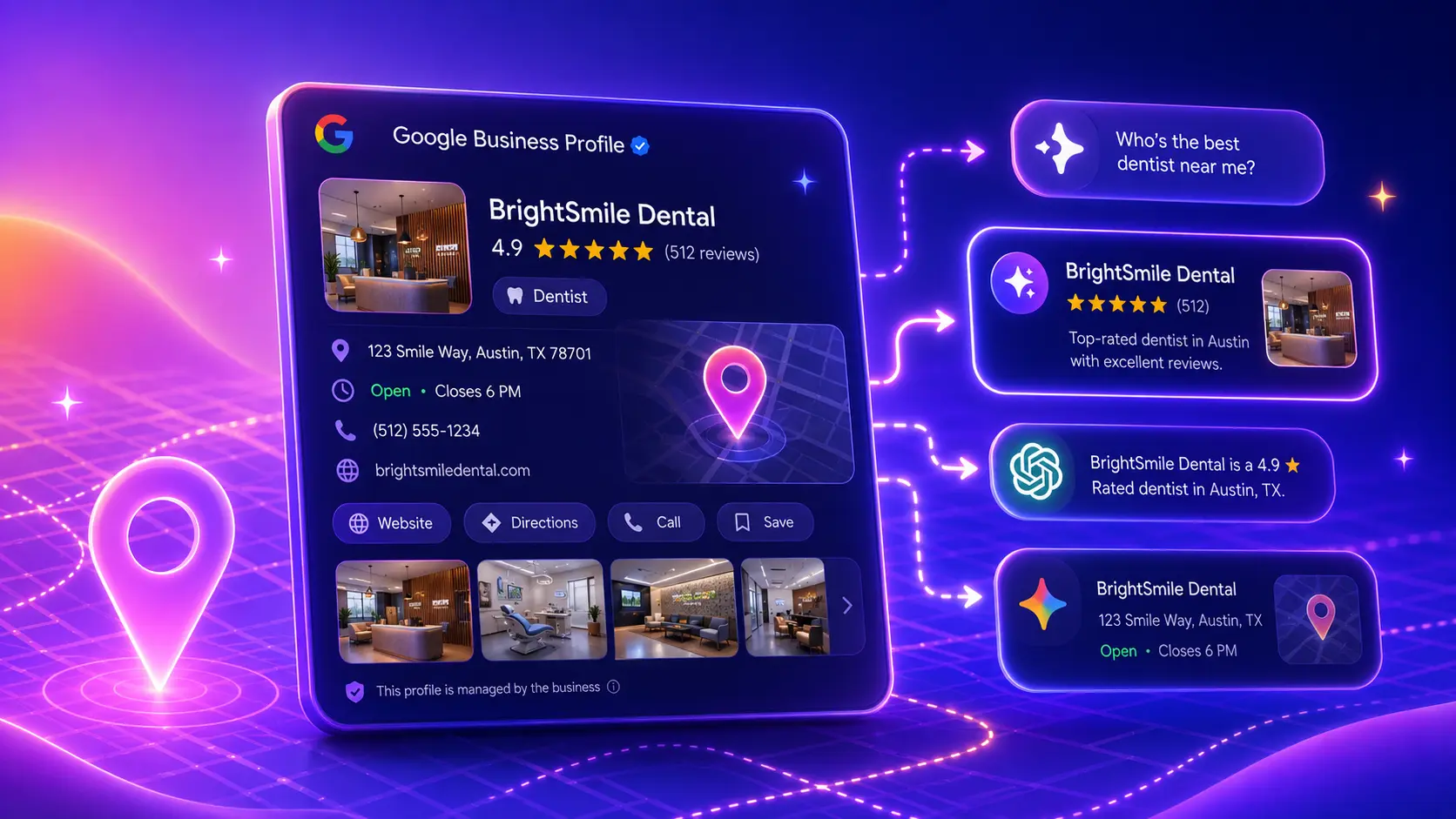
1. Your Google Business Profile. It is the structured, verified record AI engines and AI Overviews lean on hardest for "near me" intent — your category, services, hours, location, and reviews in one trusted place.
2. Consistent business data (NAP). Your Name, Address, and Phone must match everywhere they appear. Conflicting data makes an AI engine less confident about recommending you, so it picks a competitor it can verify.
3. Reviews — volume, recency, and sentiment. AI engines read reviews to judge quality and to quote reasons ("praised for fast turnaround"). A steady stream of recent, specific reviews beats a pile of old five-stars.
4. Authoritative third-party mentions. Being named on directories, local press, industry sites, and community forums tells the model you exist beyond your own marketing — the closest thing to a vote of confidence in AI's eyes.
5. Answer-first content on your own site. Pages that state the answer up front, then back it with detail, are easy for a model to extract and quote. Buried answers get skipped.
Where AI Assistants Pull Local Business Information (2026)
The 7-Step GEO Playbook for Local Businesses
Here is the exact sequence we use. Do them in order — each step makes the next one work harder.
Step 1 — Make your Google Business Profile airtight. Claim and verify it, then complete every field: primary and secondary categories, services with descriptions, service area, hours (including holidays), photos, and a keyword-natural business description. Post updates regularly. This is the single highest-leverage GEO action for a local business.
Step 2 — Rewrite your key pages answer-first and add FAQs. Open each important page with a direct, quotable answer to the question it targets, then expand. Add a real FAQ section that mirrors how customers actually phrase questions to ChatGPT. This is the content shape AI engines extract most.
Step 3 — Add LocalBusiness and FAQ structured data. Implement LocalBusiness schema (name, address, phone, geo, hours, price range) and FAQPage schema on relevant pages. Structured data makes your facts machine-readable and unambiguous — exactly what an AI engine needs to cite you confidently. See our technical SEO approach for implementation.
Step 4 — Build review velocity with consistent citations. Ask every happy customer for a review, and make it a routine, not a one-off campaign. In parallel, fix your NAP across directories (Google, Bing Places, Apple, industry and local listings) so every source agrees. Consistency plus fresh reviews is what convinces a model you're the safe recommendation.
Step 5 — Earn the third-party mentions AI trusts. Get listed and talked about beyond your own site: local press, niche directories, partner pages, industry roundups, and genuine community answers on Reddit, Quora, and forums. These citations are how a brand-new site with no authority earns its first AI mentions.
Step 6 — Make your site machine-readable. AI crawlers like GPTBot, OAI-SearchBot, and PerplexityBot need clean, fast, crawlable HTML. Allow them in robots.txt, keep your markup semantic, and fix the page-speed issues that block both users and bots. If your site is dated or slow, a website redesign often pays for itself here.
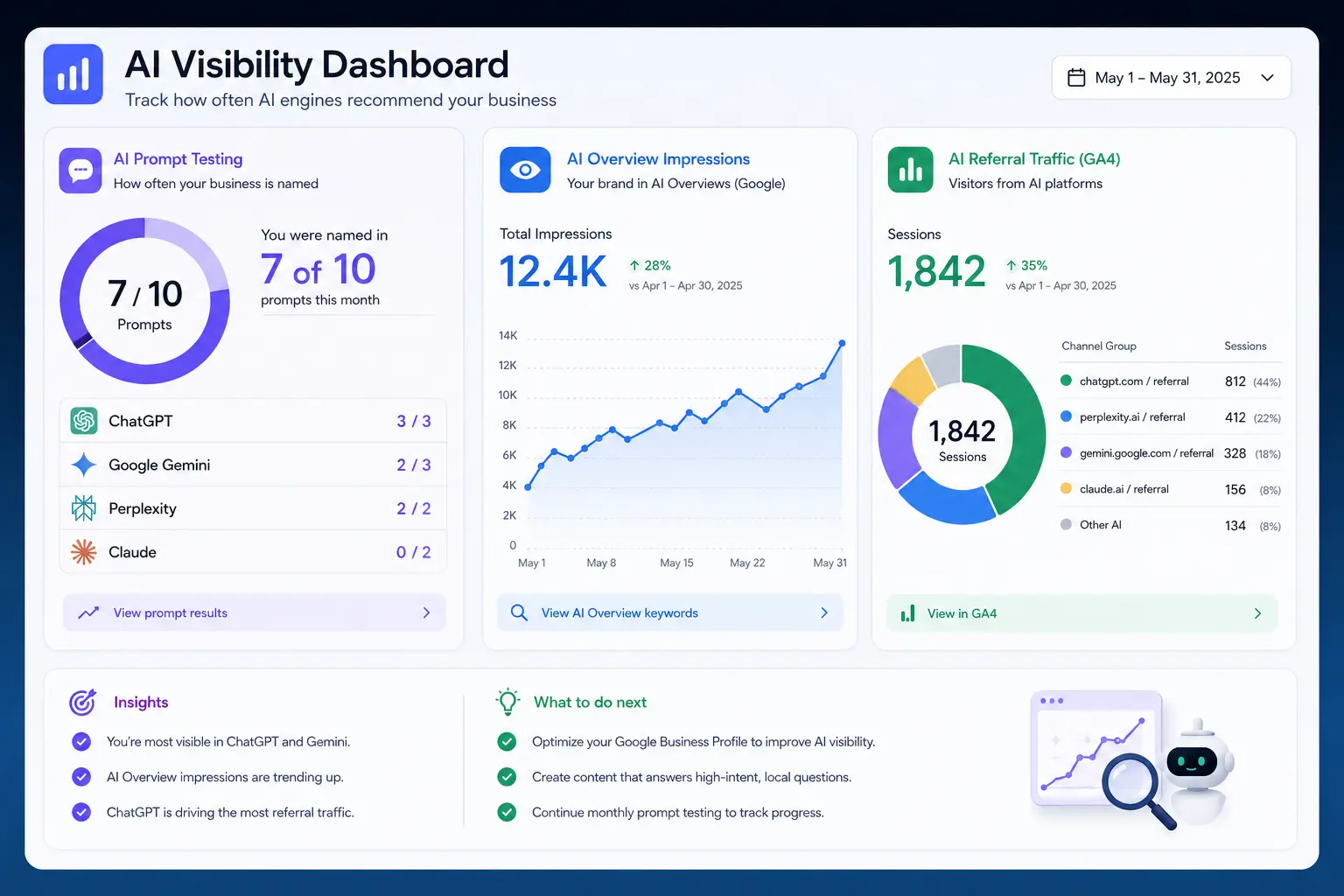
Step 7 — Measure your AI visibility. You can't improve what you can't see. Prompt-test the engines monthly ("best [service] in [city]") and record whether you're named. Track AI Overview impressions in Google Search Console, and tag AI referrals in GA4. Our guide on tracking AI and ChatGPT traffic in GA4 walks through the exact setup.
What Moves the Needle Most in GEO (relative impact)
Quick Wins vs Long-Term Plays
Not every action pays off on the same timeline. Sequence by effort and impact so you see movement fast while the slower compounding work builds underneath.
| Action | Effort | Time to impact | Payoff |
|---|---|---|---|
| Complete and verify Google Business Profile | Low | Days | High |
| Add FAQ + LocalBusiness schema | Low–Medium | 1–2 weeks | High |
| Rewrite top pages answer-first | Medium | 2–4 weeks | High |
| Launch a review-generation routine | Medium | 1–3 months | High |
| Fix NAP inconsistencies in directories | Medium | 1–2 months | Medium |
| Earn local press and industry mentions | High | 3–6 months | High |
How Long Until You Actually Show Up in AI Answers?
Be realistic. A complete Google Business Profile and schema can influence AI Overviews and local AI answers within days to a few weeks. Review velocity and citation cleanup compound over one to three months. Authority-building through third-party mentions is the long game — three to six months before it meaningfully shifts how often you're named.
If you're starting from a brand-new site with no authority, don't despair: your Google Business Profile, consistent citations, and reviews are the on-ramp. They let a local business get recommended in AI answers long before its domain could ever rank #1 in classic search.
Common GEO Mistakes Local Businesses Make
Avoid these and you'll already be ahead of most competitors:
- Treating the Google Business Profile as "set and forget." AI engines favour active, updated profiles — stale listings get passed over.
- Inconsistent NAP across the web. Even small mismatches (Ave. vs Avenue, an old phone number) erode the confidence a model needs to recommend you.
- Burying the answer. Long intros before the actual answer get skipped by extraction. Lead with it.
- No structured data. Without schema, your facts are guesses to a machine instead of confirmed truth.
- Ignoring measurement. If you never prompt-test the engines, you're optimizing blind and can't prove progress.
- Chasing AI while neglecting SEO. GEO sits on top of solid SEO — weak fundamentals cap your ceiling.
Get Found Before Your Competitors Do
AI search rewards the businesses that are easy to verify, easy to quote, and consistently vouched for across the web. In most local markets — especially in Italy and Albania — almost no one is doing this deliberately yet. That gap is your opening. Lock down your Google Business Profile, restructure your content answer-first, add schema, build reviews and citations, and measure relentlessly.
Want a partner to do it for you? Devimus builds AI search optimization and local SEO into every project. Request a free estimate and we'll map exactly where your business stands in AI search today — and how to get cited tomorrow.