


For most local businesses, the Google Business Profile brings in more enquiries than the website does. It is also the asset owners spend the least time on, usually because it was set up once during the first week of trading and never opened again.
This is the maintenance guide. It assumes you have read our local SEO guide for small businesses and want to go deeper on the single component that produces the most calls. Every section below is something you can change this week.
Why the profile outranks your own website
When someone searches for a service near them, Google shows a map with three business listings above the organic results. Those three take the majority of clicks for that query. Your website, however good, is competing for attention below them.
Google names three factors behind which businesses appear there in its local ranking guidelines: relevance, distance and prominence. You cannot change distance. Relevance and prominence are almost entirely driven by your profile and your reviews. Moz's breakdown of local ranking factors reaches the same conclusion from independent research.
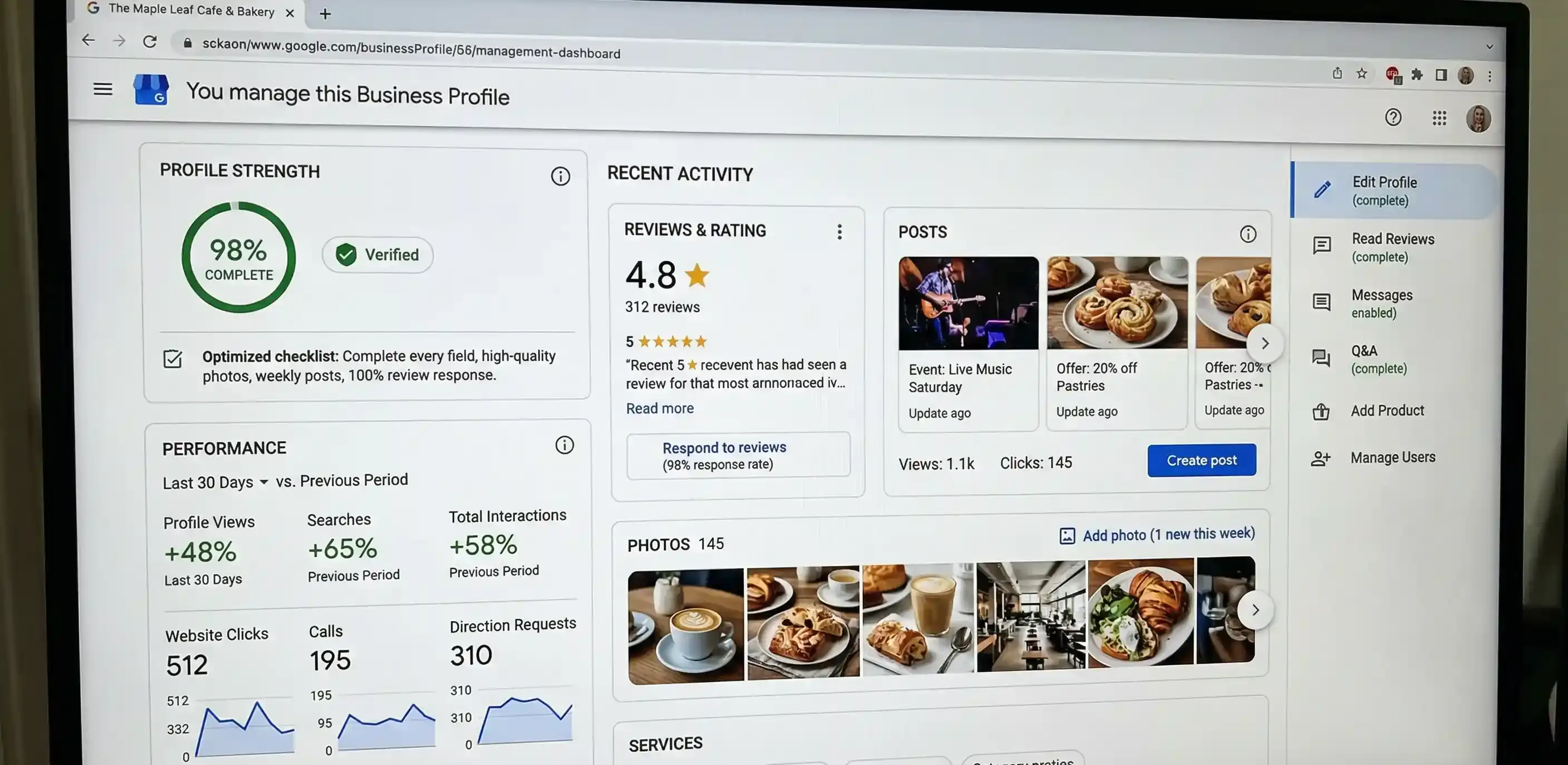
Categories are the highest-leverage field on the profile
Your primary category does more to determine which searches you appear in than anything else on the profile. It is also the field most businesses set carelessly and never revisit.
Pick the category that describes what you primarily are, not what you also do. A firm that mostly does house removals and occasionally clears offices should be a moving company first. Adding secondary categories is worthwhile, but they carry considerably less weight, and adding ten of them dilutes rather than broadens.
One practical test: search the terms you want to rank for and look at which categories the businesses in the map pack are using. If none of them share your primary category, that is a signal worth acting on.
Services, which most profiles leave empty
The services section lets you list every individual thing you do, each with its own description. It is free text, it is indexed, and the majority of profiles in most markets leave it blank or list three generic items.
Fill it out properly. Every distinct service gets its own entry with a description written in the words customers use, not internal terminology. If people ask for a "man and van" and your listing says "single-item logistics", you are invisible to that phrasing.
This is genuinely tedious work, which is why it goes undone, and it is one of the places AI can take the drafting off your hands provided you edit the output.
Photos, and what Google does with them
Photographs affect whether someone chooses you far more than they affect ranking. A profile with twelve real photos of the premises, the vehicles and the team converts better than one with a logo and nothing else.
Use original photography. Stock images are recognisable and they undermine the impression that the business is real and established. Upload consistently rather than in one batch, and cover the things a customer wants reassurance about: your vehicles, your staff in uniform, completed work, and the inside of your premises if customers visit.
The questions section nobody fills in
Google lets anyone ask a question on your profile, and it lets you both ask and answer them yourself. Most businesses ignore this entirely, which means the section either sits empty or gets answered by strangers guessing.
Seed it. Write out the eight questions you get on the phone every week and answer them. Pricing structure, how far you travel, how much notice you need, whether you are insured. These answers surface directly in search results and they remove the friction that stops people calling.
Posts, and the consistency problem
Profile posts are short updates that appear on your listing. Their direct ranking effect is modest, but an active profile signals an operating business, and posts occupy space in your listing that would otherwise be blank.
The realistic failure mode is not doing them badly, it is stopping after two weeks. One post a week is more valuable than a burst of daily posts followed by three months of silence.
Reviews, and replying to all of them
Review count and average rating sit next to your name in the map pack, which means they influence the click before they influence the ranking. BrightLocal's consumer review research has tracked how heavily buyers weigh them for years, and for local services the effect is close to decisive.
Two rules cover most of it. Ask every satisfied customer, at the moment the job finishes rather than a week later. And reply to every review, including the positive ones, in a way that references the actual job. Generic replies are worse than none, because they read as automated to exactly the audience you are trying to reassure.
Never buy reviews. Google's guidelines for representing your business prohibit it and enforcement has become considerably better at spotting it.
Service areas versus a physical address
If customers come to you, show your address. If you travel to them, configure service areas instead and hide the address. Google documents the service area business setup and getting this wrong is a common cause of suppressed listings.
Be honest about coverage. Listing thirty towns you would technically drive to does not make you rank in thirty towns, and it dilutes the relevance signal for the ones where you actually work.
Keeping your data consistent everywhere
Your business name, address and phone number need to match across every directory that lists you. Where they conflict, search engines cannot confidently resolve which records refer to the same business, and prominence suffers.
This is a one-off cleanup for most businesses, and the trigger for redoing it is any change of premises or phone number. Structured data helps here too: marking up your details with LocalBusiness schema states the same facts on your own site in a form machines read reliably.
Measuring the profile rather than guessing
The profile has its own performance data covering calls, direction requests, website clicks and the searches that surfaced you. For many local businesses those numbers matter more than website analytics, because the customer never reaches the website at all.
Pair it with Google Search Console for the site side. Between the two you can see which queries produce contact and which produce nothing.
A maintenance routine that survives a busy month
- Weekly: reply to new reviews, publish one post, check for questions left unanswered.
- Monthly: add any new services, upload a few photographs, review the insights for sharp changes.
- Quarterly: re-check your primary category against the map pack, verify your details across directories, and reassess whether your service areas match where work is actually coming from.
Set up or claim your listing through Google Business Profile if you have not already. If the profile is in order and the rest of your local presence is not, our local SEO work covers the wider picture, and a free audit will tell you which part is holding you back.