


Every local business owner has been told to "use AI" this year. Very little of that advice explains which parts of AI actually move you up in local search results, and which parts are a distraction that will cost you rankings if you get them wrong.
This guide is the practical version. It assumes you already know the fundamentals covered in our local SEO guide for small businesses and want to know where AI genuinely helps: research, content production at scale, review handling, and measurement. It is also direct about the places where AI does nothing for you, because that is where most small businesses waste their time.
Where AI has actually changed local search
Two things changed, and they matter for different reasons.
The first is on the results page. Google now answers a large share of queries directly with AI-generated summaries, and those summaries frequently pull in local businesses. Google documents how these AI features in Search select and cite sources, and the short version is that the same signals which earn you organic visibility also make you eligible to be summarised. There is no separate AI ranking system to game.
The second is off the results page entirely. People ask assistants and chatbots for recommendations now, in language they would never type into a search box. "Which movers near me can do a third floor flat with no lift on a Saturday" is a real question people ask a model. We covered this shift in detail in getting found on ChatGPT and AI Overviews.
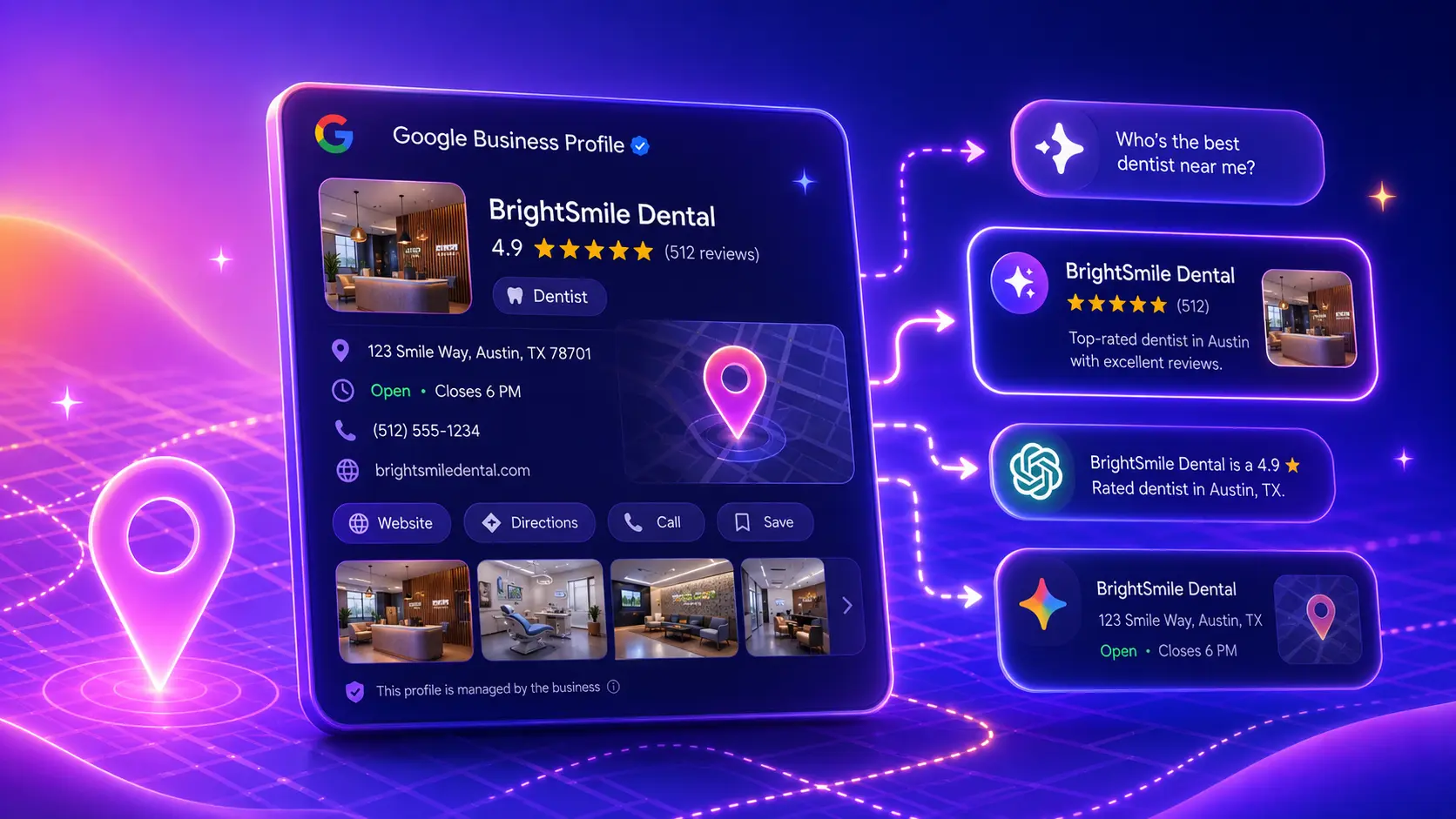
Both surfaces read the same underlying data about your business. Your Google Business Profile, your website content, your reviews, and your citations. Which means the work is familiar, even if the destination is new.
What AI will not do for your local rankings
This section matters more than the ones below it, because believing the opposite is expensive.
AI cannot change your proximity. Distance from the searcher is one of the three factors Google names in its local ranking guidelines, alongside relevance and prominence. No amount of content changes where your premises are.
AI cannot earn your reviews. Review count and rating carry real weight in local search, and they come from doing the work well and asking customers afterwards. A model can help you write the request. It cannot make anyone leave one.
AI cannot fix inconsistent business data. If your name, address and phone number differ across directories, that is a data cleanup job. Sit down and do it once, properly.
AI content on its own will not rank. Google's guidance on creating helpful content is explicit that the question is whether content is useful and demonstrates real knowledge, not how it was produced. Published output that says nothing a competitor's page does not already say will sit unindexed regardless of how it was written.
With that established, here is where AI genuinely earns its place.
Local keyword research at a scale you could not do manually
This is the strongest use case, and the most underused.
Local search is enormously varied. The same service gets searched as "emergency plumber", "plumber open now", "burst pipe help", and the name of the specific fixture that broke. Multiply that by every town in your service area and you have hundreds of variations that no one is going to map out by hand.
A language model is good at exactly this: taking a seed list from a keyword tool and expanding it into intent groups. Pull your base terms from a proper data source first, since a model does not know real search volumes, then use it to cluster and organise. Semrush's overview of what local SEO involves is a reasonable starting framework, and Moz's breakdown of local ranking factors is worth reading before you decide which clusters deserve a page.
The output you want is a list grouped by what the searcher is trying to do:
- Emergency intent. Someone with a problem right now. These convert immediately and tolerate a higher price.
- Research intent. Someone comparing options and costs, usually days or weeks ahead.
- Service plus area. The bread and butter of local search, one for each town you cover.
- Question intent. The queries that AI summaries answer, and where being the cited source pays off.
Producing service area pages without producing thin content
Here is where most businesses using AI go wrong, and the failure mode is severe enough to damage the rest of your site.
The temptation is obvious. You cover thirty towns, you need thirty pages, and a model can write thirty pages in an afternoon. What you get is thirty near-identical pages with the place name swapped, which Google identifies easily and commonly excludes from the index entirely.
The workable approach uses AI for structure and drafting while you supply what makes each page real:
- Landmarks, districts and street types specific to that area
- Access conditions that genuinely differ, such as parking restrictions or narrow historic streets
- Jobs you have actually completed there, with detail
- Local pricing factors, including travel time or congestion charges
- Reviews from customers in that area
If you cannot supply at least three of those for a town, do not publish a page for it yet. A smaller set of genuinely local pages outranks a large set of generated ones, and it will not put the rest of your site at risk.
Your Google Business Profile is still the highest leverage asset
For most local businesses the profile drives more enquiries than the website does. AI helps around the edges rather than at the centre.
Where it helps: drafting service descriptions for every item you offer, writing the answers in the Q&A section before customers ask, and keeping profile posts running consistently instead of stopping after two weeks. All of this is text production, which is what models are for.
Where it does not: choosing your primary category, defining your service areas honestly, and uploading photographs of your actual premises and staff. Those are decisions and assets, not text. Set your profile up through Google Business Profile directly and treat the category choice as a decision worth an hour of thought, because it constrains everything else.
Review handling, which is where the time actually goes
Reviews influence both rankings and whether anyone clicks you once they see you. BrightLocal's ongoing consumer review research has tracked how heavily buyers weigh them for years, and the finding has been consistent: they are close to decisive for local services.
The problem is not knowing that. It is that replying to every review properly takes time nobody has, so it stops happening.
This is a genuinely good AI use case, with one condition. Use it to draft, then edit every reply before it posts. A reply that reads as automated does more damage than no reply, particularly on a negative review where the customer is already annoyed. Feed the model the specifics of the job so the response references something real.
It is also useful in the other direction. Paste six months of reviews in and ask what customers consistently praise and complain about. The complaints are your operational to-do list. The praise is the language your service pages should be using, because it is how your customers actually describe the value.
Structured data, so machines can read your business
Both search engines and assistants rely on structured data to understand what a business is and where it operates. Google's specification for LocalBusiness structured data lists exactly what to mark up: address, opening hours, service area, price range and reviews.
This is a place AI is straightforwardly useful. Describe your business and ask for valid JSON-LD, then validate the output before it ships, since models regularly produce schema that looks right and fails validation. Our guide to schema markup covers the validation step and the types worth implementing, and the technical SEO work sits alongside it.
Measuring whether any of this worked
Effort without measurement is guessing, and local businesses guess more than most.
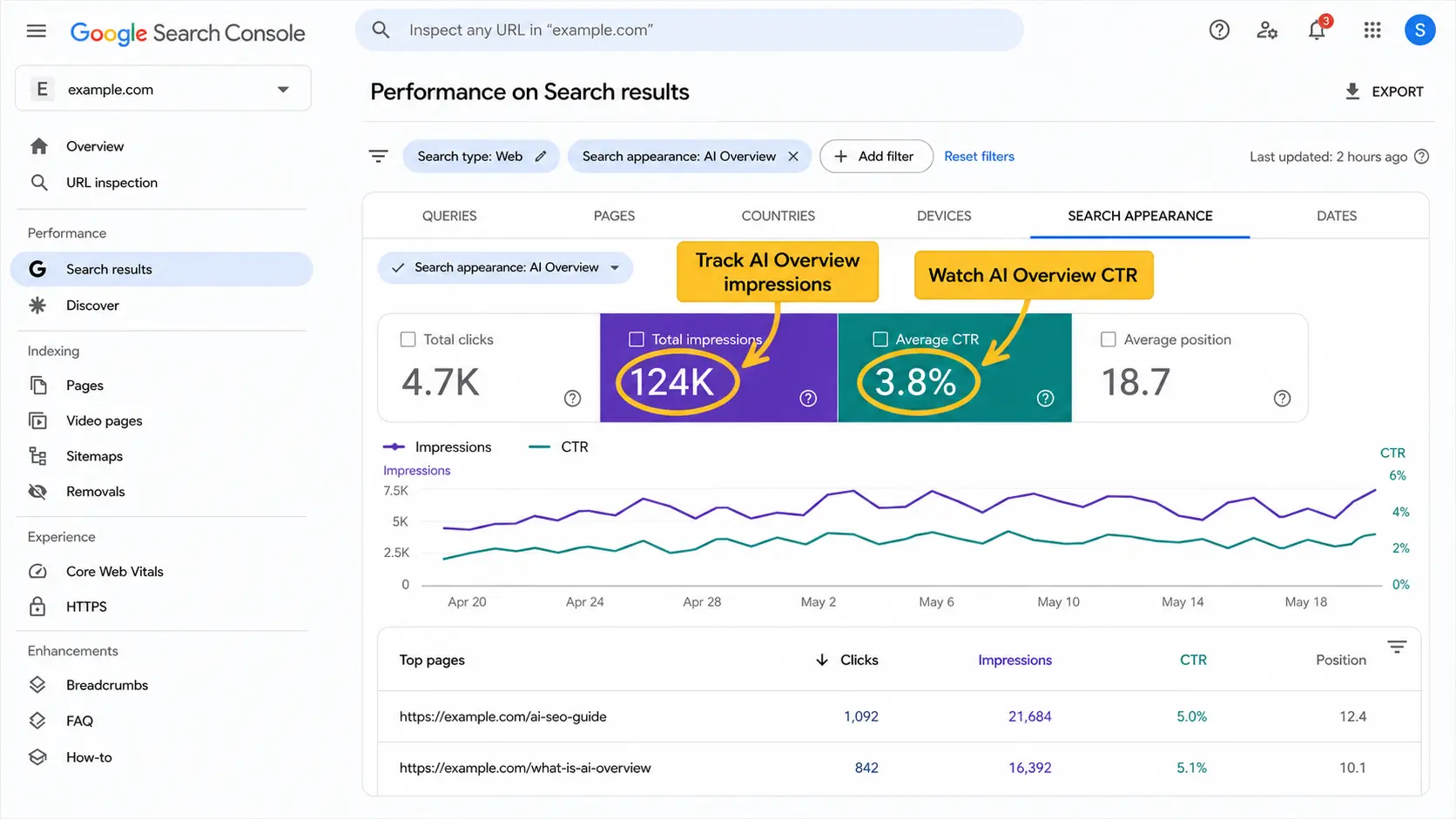
Set up the basics properly. Google Search Console shows the queries bringing people to your site and which pages earn them. Your Business Profile has its own performance data covering calls, direction requests and website clicks, which for many local businesses is the number that matters most.
AI traffic is harder, because visits from assistants often arrive without clean attribution and get filed as direct. We wrote up how to separate that out in tracking AI traffic in Google Analytics. If you would rather not build the reporting yourself, analytics and reporting is something we set up as part of an engagement.
A weekly routine that fits around running a business
None of this works as a one-off. It works as a habit, and it needs to be small enough to survive a busy week.
Weekly, about an hour. Reply to every new review. Publish one profile post. Check your Business Profile insights for anything that moved sharply.
Monthly, about half a day. Publish or substantially improve one service area page. Review Search Console for queries you are close to ranking for. Check that your business details still match everywhere.
Quarterly. Re-run your keyword clustering, since local demand shifts. Audit your service area coverage against where enquiries are actually coming from. Read your reviews as a body of feedback rather than individually.
The businesses that win local search are rarely the ones with the cleverest tooling. They are the ones still doing this in month nine.
Where AI fits in the wider picture
Treat AI as leverage on work you already understand, not a replacement for it. It makes research faster, drafting cheaper and review management sustainable. It does not change proximity, it does not earn reviews, and it will not rescue a business with inconsistent data and no reviews.
If you are starting from scratch, work through the local SEO fundamentals first and add AI to the parts that are slow. If the fundamentals are in place and you want the AI layer built properly, AI SEO and local SEO are both things we do, and a free audit will tell you which of the two you actually need.