


Google Ads can turn a small budget into steady leads, but only if you treat it like an investment with a target return, not a slot machine. The businesses that win in 2026 pick the right campaign type, track real conversions instead of clicks, and know their break-even ROAS before they spend a single euro. This playbook shows you how to do all three without the agency jargon.
If you are a plumber, dentist, boutique owner, or B2B service provider spending €500 to €5,000 a month, this guide is for you. We will cover when Google Ads beats SEO, which campaign types actually work for small budgets, how to write ads people click, and the math that tells you whether you are making money or just making noise.
Google Ads vs SEO: Which One First?
The honest answer: they solve different problems, and most small businesses eventually need both. But if you only have budget for one right now, the decision comes down to time and intent.
Choose Google Ads when:
- You need leads this week, not in six months.
- You are launching a new product, location, or promotion.
- Your customers search with clear buying intent ("emergency electrician near me," "dentist accepting new patients").
- You want to test which keywords and offers convert before investing in content.
Lean toward SEO when:
- Your margins are thin and paid clicks are expensive in your niche.
- You are building a brand and content asset that compounds over years.
- Most of your searches are informational, where paid ads convert poorly.
The smartest play is usually a hybrid: run Google Ads to capture demand today while search engine optimization builds the free traffic that lowers your cost per lead over time. Ads give you data on what converts, and that data makes your SEO and content sharper.
The Three Campaign Types That Matter
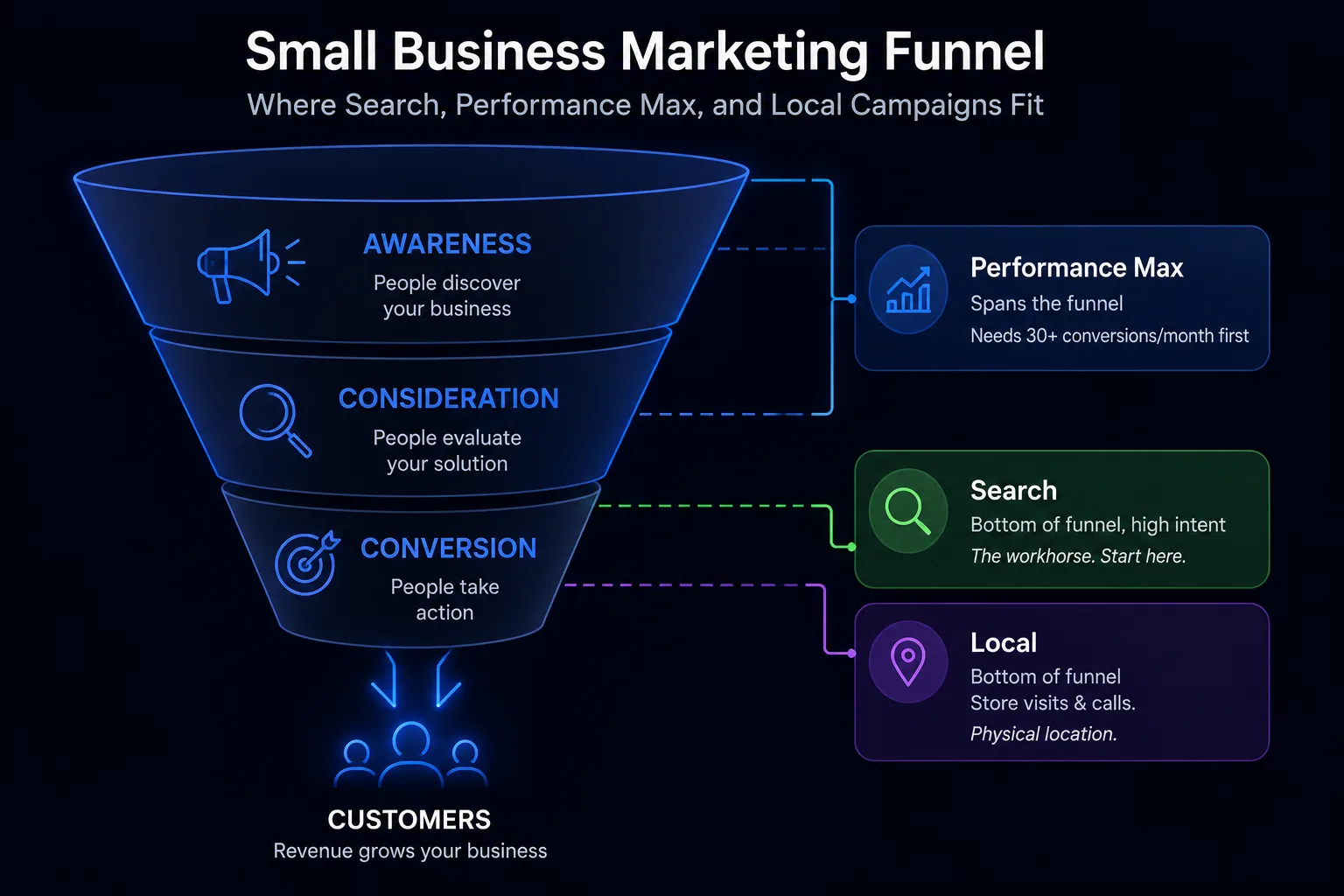
Google offers a dozen campaign formats, but a small business realistically needs three. Pick based on what you sell and where your customers are.
Search campaigns: the workhorse
Text ads on the results page, triggered by keywords. This is where high-intent searches live, and it is almost always where a small business should start. You control the keywords, the message, and the landing page. For most service businesses, Search delivers the cleanest, most measurable leads.
Performance Max: powerful but demanding
Performance Max (PMax) runs one campaign across Search, Display, YouTube, Gmail, and Maps using Google's AI. It can be excellent for e-commerce and businesses with strong conversion data, but it is a black box. Google decides where your budget goes. Do not start here unless you already have conversion tracking working and at least 30 conversions a month to feed the algorithm. Without that data, PMax burns budget on low-quality placements.
Local campaigns and Performance Max for stores
If you have a physical location, campaigns that promote store visits, calls, and directions through Google Maps and Search are gold. They pair naturally with strong local SEO and a well-optimized Google Business Profile. For a restaurant, clinic, or shop, driving calls and directions is often more valuable than website clicks.
Keyword Match Types in 2026
Match types tell Google how loosely to interpret your keywords. They have loosened significantly over the years, so understanding them prevents wasted spend.
- Exact match
[emergency plumber london]— shows for that search and very close variants. Tightest control, highest intent, usually the best CPC efficiency for small budgets. - Phrase match
"emergency plumber"— shows when the meaning of your phrase is included in the search. A good balance of reach and control. - Broad match
emergency plumber— shows for anything Google considers related. In 2026, broad match leans heavily on AI and your conversion signals. It can work well with Smart Bidding and solid conversion tracking, but it is dangerous with a manual, low-budget setup.
Practical rule for small budgets: start with exact and phrase match. Add broad match only once conversion tracking is proven and Smart Bidding has data to steer it. Whichever you choose, build a negative keyword list from day one to block irrelevant searches like "free," "jobs," "salary," and "DIY." Reviewing your search terms report weekly and adding negatives is the single highest-return habit in Google Ads.
Budgets and Realistic CPCs: An Honest Look
Here is the truth most agencies avoid: Google Ads has a minimum viable budget, and it varies wildly by industry. Cost per click (CPC) is driven by competition.
- Local services (cleaning, tutoring, trades): often €1 to €5 per click.
- Professional services (lawyers, dentists, B2B software): €5 to €30+ per click.
- Insurance, legal, and finance: can exceed €50 per click.
Do the math before you commit. If your CPC is €4 and one in twenty clicks becomes a lead (5% conversion rate), each lead costs €80 in ad spend. If you close one in four leads and a customer is worth €600, the numbers work. If a customer is worth €120, they do not.
A realistic minimum: for most local service businesses, budget at least €500 to €1,000 a month plus enough patience to gather 4 to 6 weeks of data. Spreading €200 across ten keywords in a competitive market gets you too few conversions to learn anything. Concentrate budget on your best keywords and best hours rather than spreading it thin.
Writing Responsive Search Ads That Get Clicks
Responsive Search Ads (RSAs) let you supply up to 15 headlines and 4 descriptions, and Google mixes them to find winning combinations. Give the algorithm strong raw material.
Headlines that earn clicks:
- Include the searcher's keyword in at least a few headlines ("Emergency Plumber in Milan").
- Lead with a clear benefit or offer ("Same-Day Service," "Free Quote in 60 Seconds").
- Add proof and specifics ("Rated 4.9 by 300+ Clients," "Licensed & Insured Since 2009").
- Include a direct call to action ("Call Now," "Book Online Today").
Descriptions should expand on the offer, address objections (pricing, guarantees, speed), and end with a call to action. Use ad assets (formerly extensions): sitelinks, callouts, call buttons, location, and structured snippets. They make your ad bigger, raise CTR, and are free. Match the promise in your ad to the exact message on your landing page. A mismatch tanks both conversions and Quality Score.
Landing Pages and Quality Score
Where you send the click matters as much as the ad. Sending paid traffic to your homepage is one of the most common ways small businesses waste money. Build dedicated landing pages that match each ad's promise.
Quality Score is Google's 1-to-10 rating of your keyword, ad, and landing page relevance. A higher score means you pay less per click and rank higher. The three levers:
1. Expected CTR — write compelling, relevant ads. 2. Ad relevance — keep tight keyword-to-ad groups so the ad matches the search. 3. Landing page experience — fast load, mobile-friendly, relevant content, clear next step.
Page speed feeds directly into landing page experience, so slow pages cost you twice: worse conversions and higher CPCs. If your site struggles on mobile, fixing Core Web Vitals pays for itself in ad efficiency. A landing page needs one job: one clear offer, one form or phone number above the fold, and no distracting navigation.
Conversion Tracking and ROAS Math
You cannot optimize what you cannot measure. Running Google Ads without conversion tracking is like driving with the windshield painted over.
Set up tracking properly
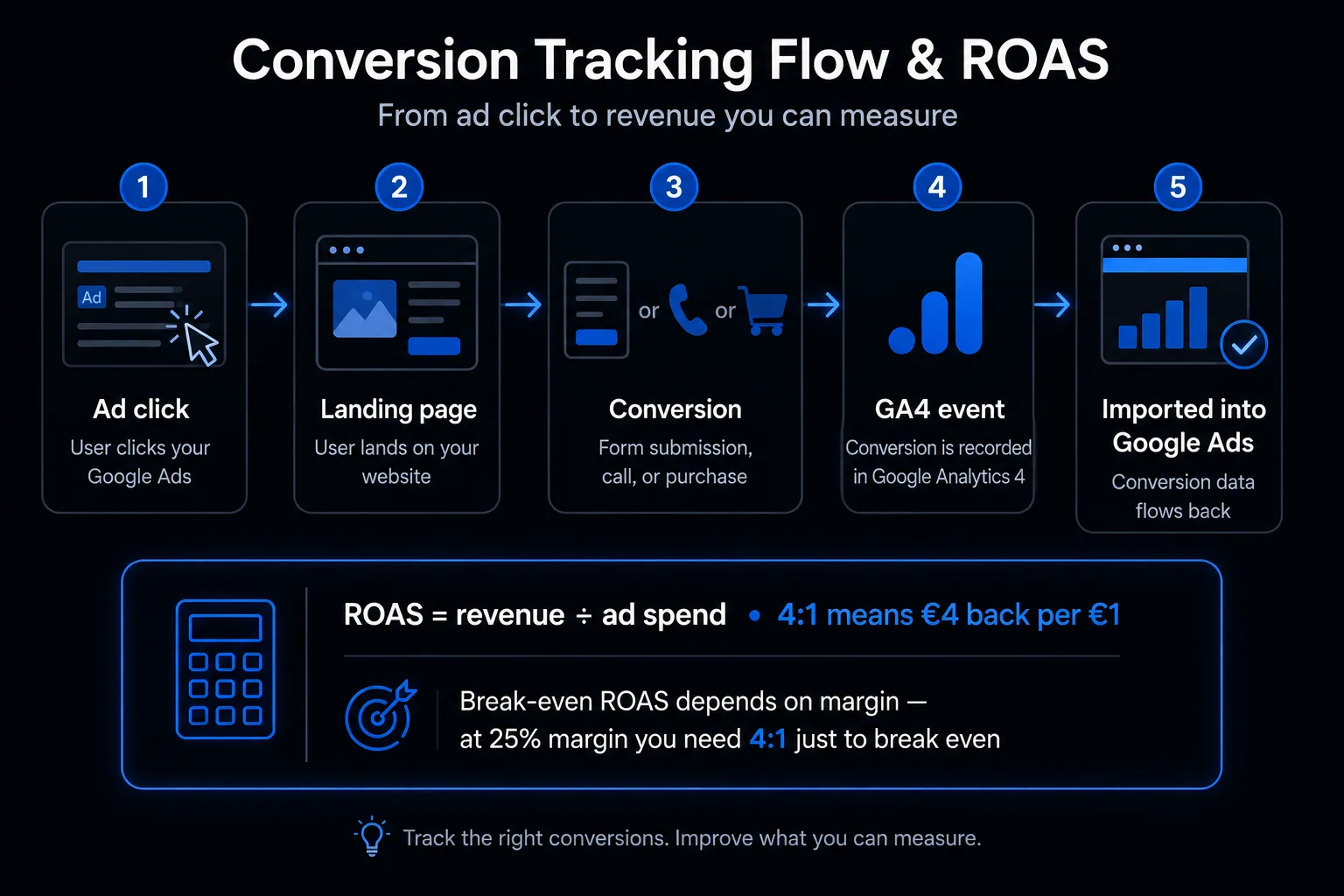
Define what a conversion is for your business: a form submission, a phone call, a booking, a purchase. Then track it. Connect Google Analytics (GA4) to Google Ads, import your key conversion events, and enable enhanced conversions for better accuracy as third-party cookies fade. For phone-heavy businesses, use call tracking so a phone lead counts just like a form fill. Be aware that AI-driven and privacy-first browsing is making attribution messier — our guide on tracking AI traffic in GA4 covers the gaps that quietly distort your reporting.
The ROAS math every owner should know
ROAS (Return on Ad Spend) = revenue from ads ÷ ad spend. A 4:1 ROAS means €4 back for every €1 spent. But the number that actually keeps you in business is your break-even ROAS, which depends on your profit margin.
If your gross margin is 25%, your break-even ROAS is 1 ÷ 0.25 = 4.0. That means you need at least €4 in revenue per €1 of ad spend just to cover the cost of goods. Anything above 4:1 is profit; anything below is a loss, even though the revenue looks positive. Know this number cold before you scale. For lead-gen businesses, track cost per acquisition (CPA) against customer lifetime value instead: if a customer is worth €600 in profit and costs €150 to acquire, you have room to spend more aggressively.
AI-Driven Bidding: Let the Machine Do the Math
Google's Smart Bidding uses machine learning to set bids for each auction based on likelihood to convert. In 2026 it is genuinely good, but only if you feed it clean conversion data.
- Maximize Conversions / Target CPA — best when you want the most leads at a controlled cost per lead.
- Maximize Conversion Value / Target ROAS — best for e-commerce where different sales are worth different amounts.
- Manual or Maximize Clicks — fine for the first few weeks while you gather conversion data, then switch to a smart strategy.
The catch: Smart Bidding needs volume. Below roughly 15 to 30 conversions a month, the algorithm lacks signal and can make erratic choices. Small accounts should start with a simple strategy, prove conversion tracking, then graduate to Target CPA once the data flows. Do not stack every AI feature at once. Change one variable at a time so you can tell what is working.
Common Money-Wasting Mistakes
- No negative keywords. You pay for "free," "cheap," and "jobs" searches that never convert.
- Sending clicks to the homepage instead of a focused landing page.
- No conversion tracking, so you optimize for clicks instead of customers.
- Broad match with manual bidding on a small budget — a fast way to burn cash.
- Ignoring mobile. Most local searches are on phones; a slow or clunky mobile page kills your ROAS.
- Set-and-forget. Google Ads rewards weekly attention: search terms review, bid adjustments, and ad testing.
- Bidding on everything at once. Start narrow with your most profitable keywords, then expand from proven winners.
Google Ads is not passive income. Treat it like digital marketing that needs a hand on the wheel, and pair it with social media ads once search is profitable and you want to build demand beyond people already searching.
Putting It All Together
Start small and focused: one Search campaign, a handful of exact and phrase keywords with clear buying intent, a dedicated landing page, and conversion tracking wired to GA4. Know your break-even ROAS before you spend. Give it 4 to 6 weeks, review the data weekly, cut what loses, and double down on what wins. Only then layer in Smart Bidding, broad match, or Performance Max.
Done right, Google Ads becomes the most predictable growth channel a small business can own. If you would rather have experts build and manage it while you run your business, request a free estimate and we will map a campaign to your budget and goals.