


B2B content marketing brings qualified leads when it helps a buyer make a work decision: which approach to take, what a project involves or which supplier fits. Broad educational traffic can still be useful, but it should not be mistaken for demand from companies ready to hire. This guide explains how to find the questions that matter, write for the whole buying group, connect articles to your services and judge the results without overstating what the data shows.

Why does most B2B content attract readers rather than buyers?
Many B2B blogs are planned from keyword tools and trend lists. The result is articles that define industry terms or summarise news, which can bring visits but rarely bring an enquiry. The reader was curious, not shopping for a supplier.
Buyers search differently. They look for comparisons, costs, risks, timelines and implementation details, often late in a decision and often with colleagues involved. Google’s guidance on creating helpful, reliable content asks whether someone leaves a page feeling they have learned enough to achieve their goal. For a B2B buyer, that goal is usually a decision, so the content should be built around one.
Where do you find the questions real buyers ask?
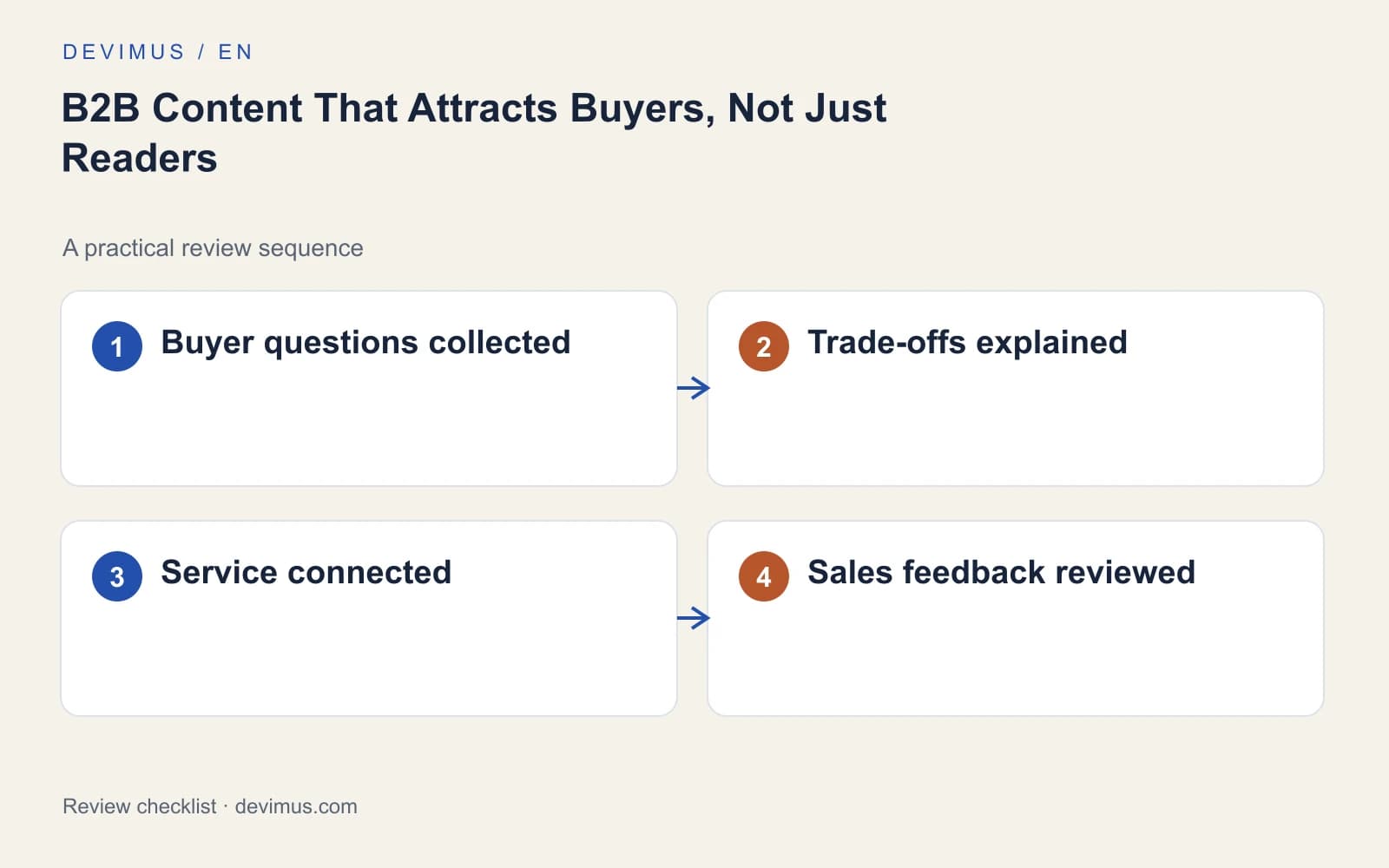
The best source is your own sales process. Collect recurring questions from proposals, discovery calls, onboarding and deals you lost. Remove personal or confidential details, then sort what remains into themes:
- Scope: what is included, what is not and what the client needs to provide
- Integration: how the service works with existing systems, suppliers or teams
- Migration and risk: what could go wrong and how it is managed
- Cost drivers: the factors that make a project bigger or smaller
- Supplier selection: what to compare and which questions to ask
Choose questions your team can answer with a concrete method, example or decision tool. If the honest answer is “it depends”, explain what it depends on. That is often the most useful article you can write, and the one competitors avoid. If your team lacks the time to turn call notes into articles, a content writing service can work from them directly.
Then check how prospects phrase these questions. Search Console queries for your existing pages, the “People also ask” questions in Google and the wording clients use in emails all help you title an article in the buyer’s language rather than your internal jargon. Low search volume is not a reason to skip a topic: a question that comes up on every sales call is worth answering even if few people type it.
How do you write for the whole buying group?
A B2B decision often involves the person who will use the service, the person who owns the budget and someone who checks the technical or legal side. Each of them needs different evidence.
| Reader | Main concern | What the content should give them |
|---|---|---|
| Day-to-day user | Will this fix my operational problem? | Process, workload and examples of the working method |
| Budget owner | Is it worth it and what will it cost? | Cost drivers, timelines and the risk of doing nothing |
| Technical reviewer | Will it fit our systems and rules? | Integrations, security, data handling and requirements |
You do not need three separate articles. One well-structured page can answer each concern under its own heading, so a reader forwarding it internally can point colleagues to the section that matters to them.
Should B2B content say when your service is not a fit?
Yes. A comparison that states when your service is unsuitable, as well as when it fits, is more credible and saves time on both sides. Readers self-select before contacting sales, so the enquiries that arrive are better matched.
This works best when you are specific. “We are not the right choice if you need a same-week launch” or “a template site may be enough at this stage” gives the reader a concrete reason to trust the rest of the page. Our guide to choosing between a custom website and a template is an example of that approach.
How do you connect an article to your service?
Use a natural link to the relevant service page at the point where the reader would logically want it, not a banner bolted to the end of every post. The service page then has to continue the conversation; our guide to service page SEO covers what that page needs.
Offer a specific next step that matches the article, such as reviewing an existing process, scoping a migration or comparing two options. “Contact us” is weaker than “Send us your current set-up and we will tell you what a migration would involve.”
How do you measure leads from B2B content?
Track assisted conversations as well as direct enquiries. Someone may read three articles, share one with a colleague and get in touch a month later through the homepage. Analytics will miss part of that journey, so acknowledge the limits instead of claiming precision you do not have.
Practical measures include which articles appear in sessions before an enquiry, which enquiries became real opportunities and whether prospects mention content on calls. Ask sales to note it. If you need help setting up that reporting, our analytics and reporting service can connect site data with your CRM stages. Then use the feedback to update articles, adding the questions prospects still ask after reading them.
An example to apply
Illustrative scenario, not a client case study.
A prospect comparing CMS suppliers needs to understand who can edit pages, how approvals work and what migration includes. A practical article comparing those workflows, with a section on when a simpler platform is enough, supports a real purchase decision and gives the sales team something useful to share. A broad article defining what a content management system is may attract readers, but it does not help anyone choose a supplier.
Discuss your project
Share your service offer and the questions that come up repeatedly in sales conversations. Devimus will propose a content plan built around the decisions your prospects need to make.
Explore the relevant service · Request a free estimate