


Service page SEO starts with the question a buyer is asking: can this business solve my problem, under the conditions that matter to me? A page that answers it clearly, with a sensible structure and real proof, tends to attract better enquiries than one written around a keyword. This guide covers how to give each page a distinct job, write from the buyer’s uncertainty, use proof well, link pages together and measure results by enquiry quality as well as rankings.

What should a service page do for the buyer?
A visitor on a service page is usually comparing suppliers. They want to know quickly whether you do the specific job they need, whether you work with businesses like theirs and what happens next. If the page reads like a general brochure, they go back to the search results and try the next one.
Search engines are trying to make the same match. For a service page, useful means specific: the service, who it is for, how it works and how to start. Everything else, from the title tag to internal links, exists to make that answer easy to find and easy to understand.
How do you give each service page one distinct job?
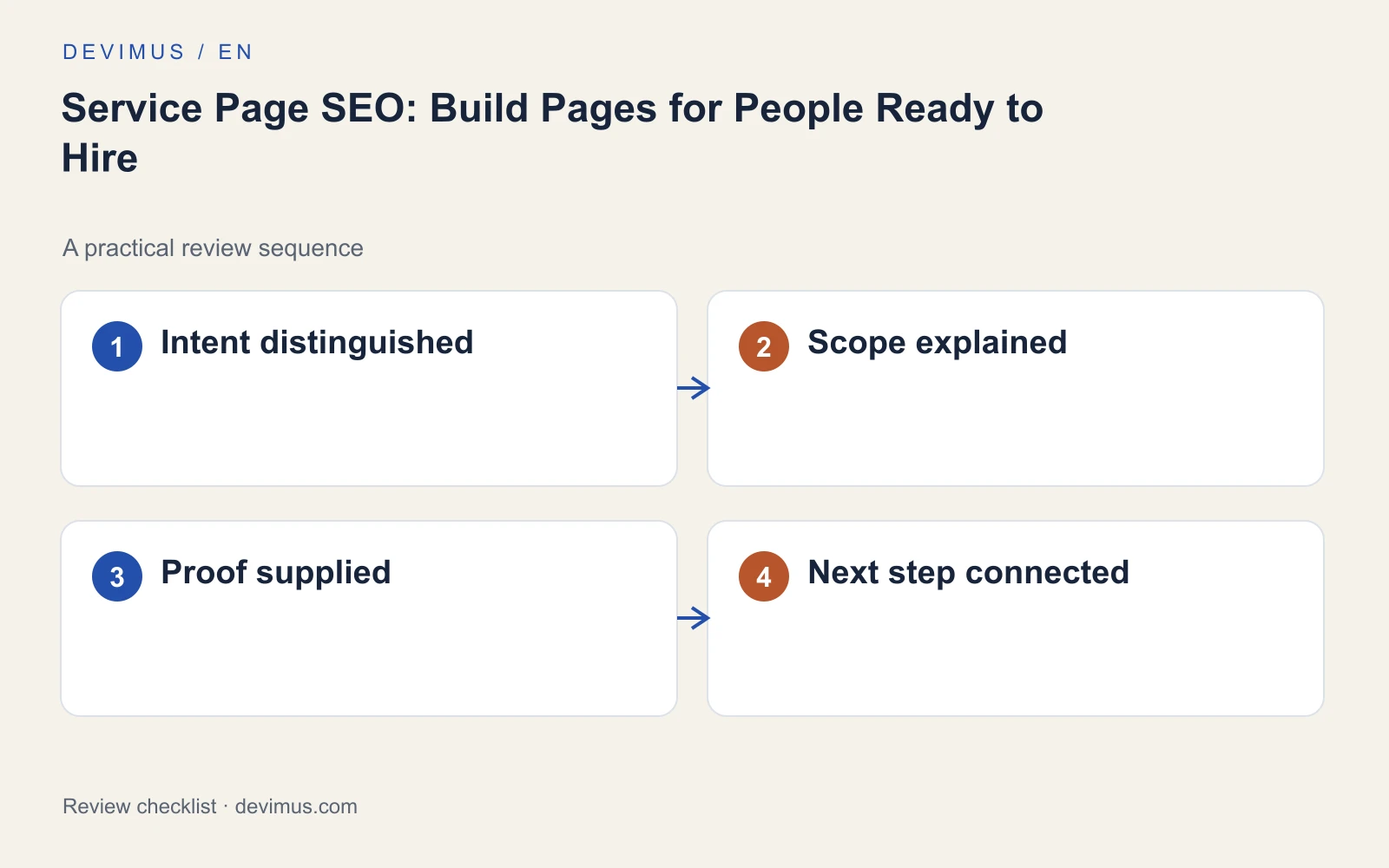
Separate services when the customer need, delivery or buying questions genuinely differ. Do not create multiple pages merely to rearrange the same keyword, such as “web design company”, “website design agency” and “web design services” on three near-identical URLs. Search engines will struggle to choose between them, and none will be as strong as one good page.
Review your existing URLs before adding another. If two pages answer the same question, improving one and redirecting the other is often more useful than expanding the site. Location pages follow the same rule: create them only when each has something genuinely local to say, as our guide to service area pages explains.
What should a service page include?
Write from the buyer’s uncertainty. Most service pages need to cover the following points, roughly in this order of importance:
- Who the service is for, and who it is not for
- What is included and what sits outside the scope
- Prerequisites, such as access, content or approvals the client provides
- The likely process and timeline, in plain steps
- Factors that affect the quote, if you do not publish fixed prices
- Proof relevant to this service, placed near the claims it supports
- A specific next step and what to prepare for it
Put the essentials in the first screen: what the service is, who it is for and how to start. On a phone, that means a clear heading, a one- or two-sentence summary and a visible contact option before any long explanation. Process detail and pricing factors can follow further down for readers who want them.
Use a descriptive title and headings that match the content. Google explains how it generates title links in search results, and a clear, accurate title tag is the simplest way to influence them. Avoid repeating a place name or keyword so often that the page becomes harder to read.
What counts as credible proof on a service page?
Proof should help a buyer decide, not decorate the page. Useful forms include work samples relevant to the service, a short description of how a past project was approached, named credentials or certifications, and genuine reviews. Place each piece next to the claim it supports: a sample of migration work belongs near the section about migration.
Avoid proof you cannot back up. Invented statistics, stock-photo “teams” and unverifiable awards damage trust when buyers check. If you are new to a service, explain your method in detail instead, because transparency about process is itself a form of evidence. Our guide to E-E-A-T and trustworthy content goes further on this.
How should service pages connect to the rest of the site?
Link the page from the relevant service hub and from articles that answer related questions, using descriptive anchor text rather than “click here”. Related services should link to each other where a buyer might need both, for example on-page and technical SEO.
Make the next step specific: a consultation, an assessment or a project estimate. Explain what information the buyer should bring, such as current URLs, examples or a budget range. A form that asks for the right details up front saves a round of emails and helps you qualify the enquiry. If the page will also receive paid traffic, consider a focused landing page for that campaign rather than sending ads to a general page.
How do you measure whether a service page works?
Review search queries and qualified enquiries together. Ranking for a broad term is less useful if the page attracts the wrong job, such as small repairs when you want full projects. Search Console shows which queries bring impressions and clicks; your enquiry records show which of those visitors became suitable leads.
If the queries do not match the work you want, adjust the scope description, headings and examples so the page describes that work more precisely. Look at several months of data before drawing conclusions, since service enquiries are often low in volume and seasonal.
An example to apply
Illustrative scenario, not a client case study.
“Website redesign” and “new business website” sound similar but involve different prerequisites. A redesign buyer needs answers about migration, existing content and protecting current rankings. A new business may need help with branding, first-time content preparation and domain set-up. When those differences are substantial, separate the pages, make the distinction clear in their introductions and link each to the other for visitors who land on the wrong one.
Discuss your project
Send Devimus the service you want to grow and the page that currently describes it. We will review it for search intent, clarity and enquiry quality, and suggest what to change first.
Explore the relevant service · Request a free estimate