


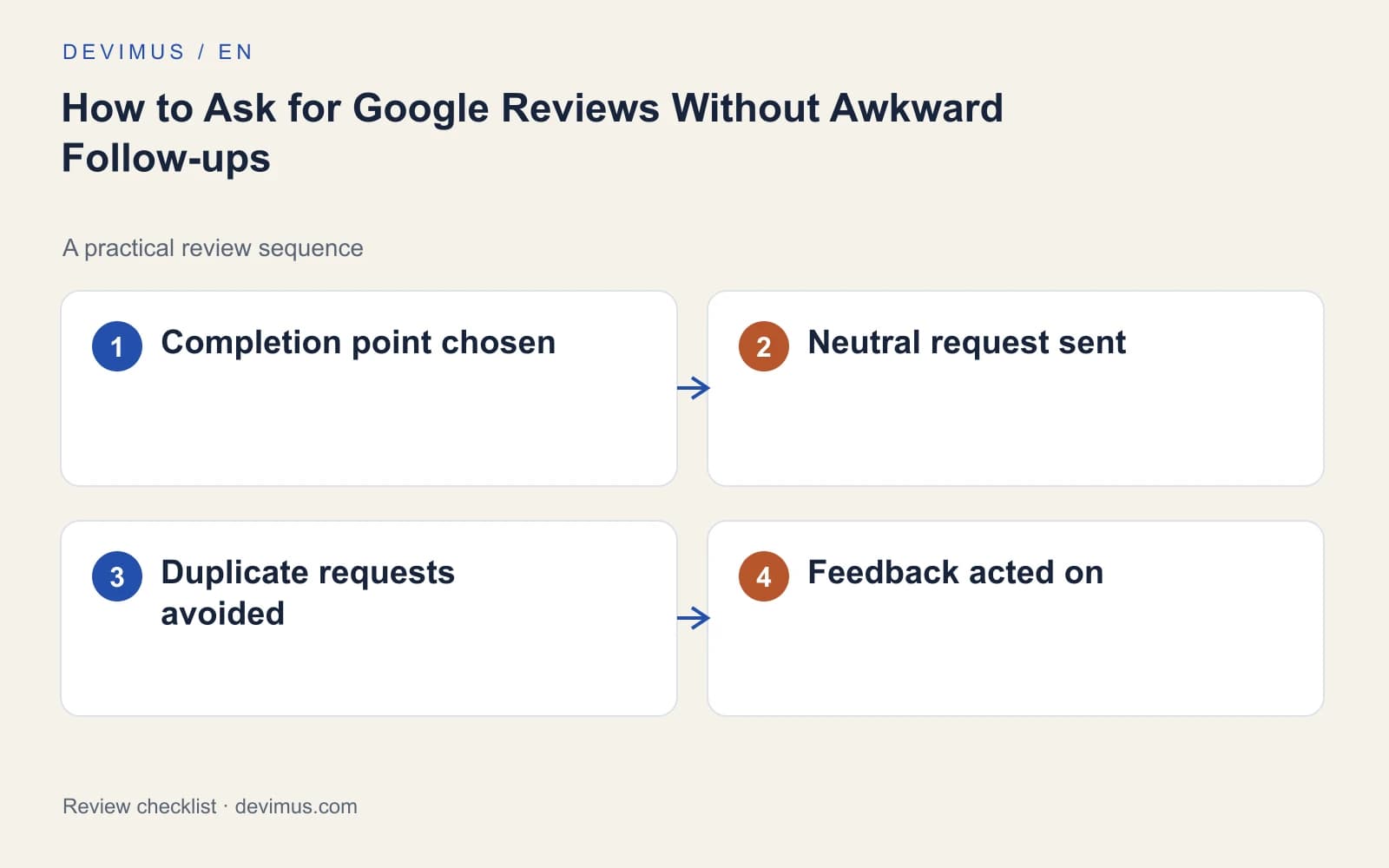
The best way to ask for Google reviews is to make it a routine step after completed work: finish the job, thank the customer and send one short, neutral message with your review link. A good process does not pressure people, screen out unhappy customers or offer rewards, all of which conflict with Google's policies. This guide covers when to ask, what to say, how to avoid duplicate reminders and how to use what customers tell you to improve the service.

When should you ask for a Google review?
Pick a natural completion point, when the customer has received what they paid for. For a trades business, that is usually the signed-off job. For a clinic or salon, it is the end of the appointment. For a removals firm, the day after the move often works better than moving day itself, once boxes are unpacked and the customer can judge the result.
Assign the request to one person or one system, so customers do not receive duplicates from different team members. Apply the same approach to every eligible customer rather than screening for likely praise. If someone has an open complaint, deal with it promptly and separately, but do not make access to the review link depend on how that complaint is handled.
What to say in a review request message
Short and plain works best. A simple message can say: "Thank you for choosing us. If you would like to share your experience, you can leave an honest review using this link." Add the link your Google Business Profile provides for reviews, so the customer lands on the right form without searching.
Personalise only the facts: the customer's name and the job you completed. That shows the message is genuine without steering what they write.
Email and text messages both work. A printed card with a QR code can suit businesses that hand over paperwork in person. Whatever the channel, keep the wording neutral. Google's policy on prohibited and restricted content is clear about the practices that put reviews, and sometimes the profile, at risk.
- Asking for five stars or any particular rating.
- Suggesting wording or offering to write the review for the customer.
- Offering discounts, gifts or prize draws in exchange for a review.
- Sending requests only to customers you expect to be positive.
- Asking staff, friends or family to review the business.
How to avoid awkward follow-ups
Most pushy experiences come from poor coordination, not bad intentions. Add a simple "review requested" field and date to your job record or CRM, and check it before anyone sends a message. If you send a reminder at all, send one, a few days later, and stop there.
Make it easy to opt out. A line such as "If you would rather not hear from us about this, just reply and we will not send another reminder" respects the customer and protects your reputation. Never chase a review by phone, and never ask again after someone has left one.
Repeat customers need a rule too. If you see the same client every month, ask once at a good point in the relationship rather than after every visit, and note it in their record so nobody asks again next time. Customers who have already reviewed you can update their review themselves if their experience changes.
How to respond to reviews, good and bad
Replying shows future customers how you treat people. Thank positive reviewers briefly and, where it feels natural, mention the type of work you did without revealing private details such as addresses or prices. Keep replies varied; copied responses read as automated.
For a negative review, acknowledge the concern, apologise where it is warranted and offer a direct contact to resolve it offline. Avoid arguing about facts in public. If a review breaks Google's content policies, for example because it is spam or from someone who was never a customer, report it through your Business Profile instead of replying with accusations. Our guide to Google Business Profile optimisation covers replies, categories and other profile settings in more detail.
How reviews fit into local search
Reviews help customers decide, and they also feed into local visibility. Google's own advice on how to improve your local ranking lists review count and score among the factors behind prominence, alongside relevance and distance. That makes a steady, honest review process a sensible part of any local SEO plan, not a one-off campaign.
Reviews are one signal among many, though. Accurate business information, a well-maintained profile and useful service area pages all contribute, as our local SEO guide for small businesses explains. Judge the review process by coverage, meaning the share of completed jobs that received one request, and by what customers tell you. Do not set staff targets for a number of five-star reviews, which creates exactly the pressure the process is meant to avoid.
Recurring comments are useful operational data. If several customers mention slow quotes or unclear arrival times, route that feedback to the person who can fix it. Better service is what earns better reviews over time.
An example to apply
Illustrative scenario, not a client case study.
A small installation company finishes a job on Friday. The technician sends a review link from his phone, and on Monday the office manager sends the standard email request. The customer receives two messages about the same job and feels chased, even though each message was polite.
A "review requested" field in the job record prevents this. The office sends the request once the job is marked complete, the technician simply thanks the customer on site, and the email includes a clear way to opt out of any reminder.
Discuss your project
Ask Devimus to review your local customer journey, Business Profile and review-request process as part of a practical local SEO plan built around how your customers actually choose.
Explore the relevant service · Request a free estimate