


Moving company SEO works when it brings enquiries you can actually fulfil: routes you cover, types of move you handle and dates your crews can take. A visitor needs to see quickly whether you serve their area, do their kind of job and can assess it accurately. Ranking for "removals near me" is only half the work. The other half is a website and Business Profile that turn those local searches into quote requests your team can price and book.

What do people searching for a moving company need to see?
Most moving searches are local and time-sensitive. People compare two or three firms, often on a phone, and decide within minutes whom to contact. They look for four answers: do you cover my route, do you handle my type of move, how does the quote work and have other customers been happy?
If any of those answers is buried, the visitor goes back to the results. That is why moving-company SEO is as much about page content and the enquiry form as about rankings. Strong visibility that lands people on a vague homepage wastes the effort.
Separate genuinely different services
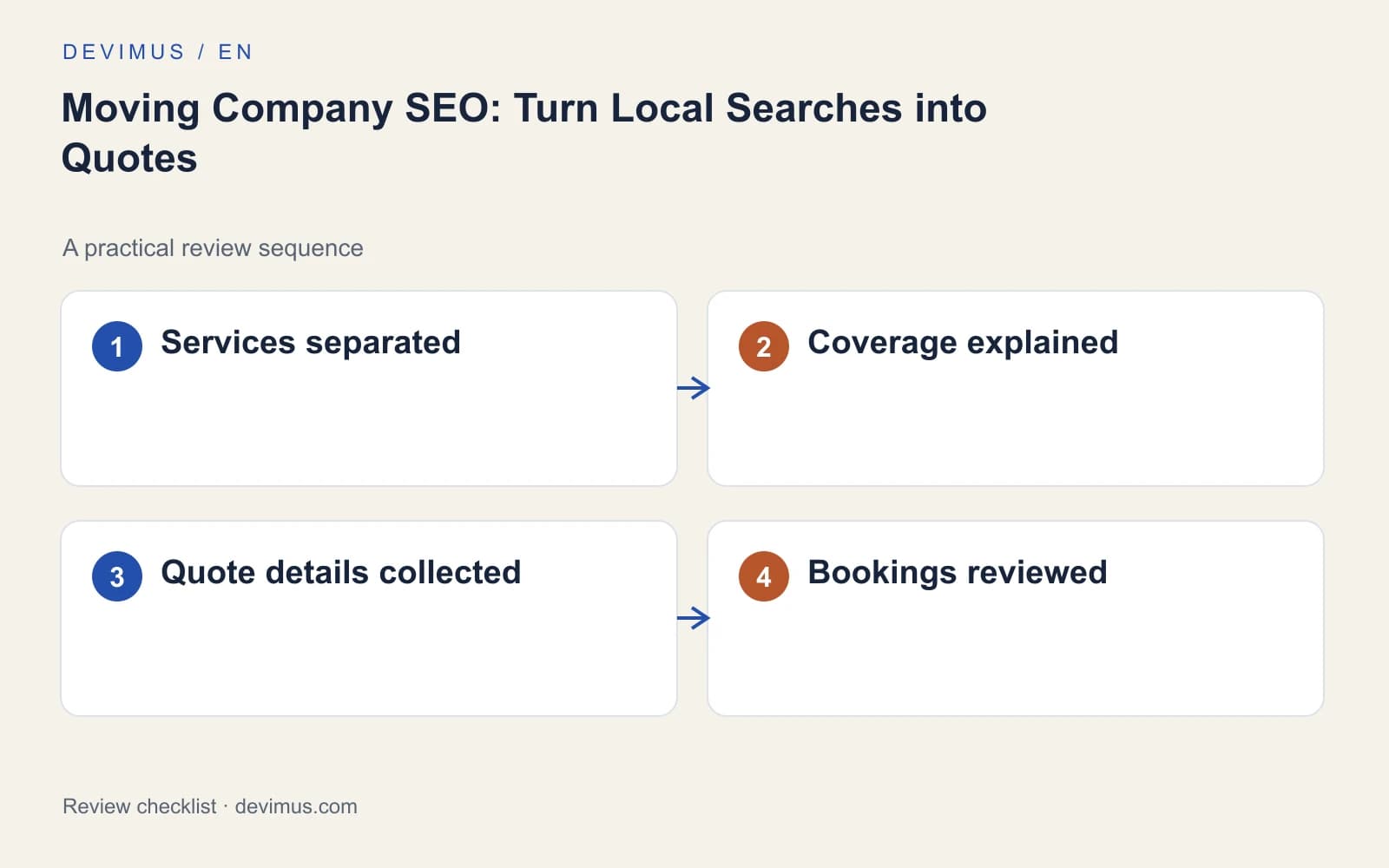
House moves, office relocations, packing, storage and specialist item moves raise different buying questions. A household customer worries about access, packing and timing. An office manager worries about downtime, IT equipment and coordinating staff. Give each important service its own page with relevant scope, process and evidence, rather than placing everything under one promise to handle any move.
Each page should answer the questions specific to that service: what is included, what costs extra, how far ahead to book and what the customer needs to prepare. That is the core of service pages built for people ready to hire, and it helps search engines match the page to the right query.
How should a moving company handle coverage and location pages?
Coverage should reflect operational reality. Describe the areas you serve regularly, how you handle long-distance routes and any limits, without implying a staffed office in every town. Google expects your profile to represent the real business, and its guidelines for representing your business rule out addresses where you do not operate.
A location page earns its place only when it carries information specific to that area: typical property types, parking or access rules, routes you run often or local storage. If the same text would serve ten nearby towns, one clear coverage page is more useful than ten near-identical pages. Our guide to service area pages that rank explains how to decide which areas deserve their own page.
Make the quote request useful
Ask for the details that materially affect the next conversation, and leave the rest for the survey. A good first enquiry collects:
- Origin and destination area (a postcode or town is often enough at this stage)
- Preferred date and how flexible it is
- Property type and size, or a short description of volume
- Access constraints such as stairs, lifts, parking distance or narrow streets
- Special items such as pianos, safes or large furniture
- Whether packing or storage is needed
Explain what the customer receives next: an initial call, a provisional estimate, or a firm quotation after a home survey or video inventory. Do not present a rough online figure as a final price when the job still needs assessment. State how stairs, parking and specialist items affect the estimate. Clear expectations reduce disputes later, after the customer has already invested time.
Keep the form short enough to complete on a phone, and mark optional fields clearly. If you offer a home survey or a video inventory, let customers request it from the same page instead of waiting for a call back. Every unnecessary step you remove keeps more of the people who were ready to ask.
Keep your Business Profile and reviews working for you
For many moving firms, the Business Profile is the first thing a local searcher sees. Keep categories, service area, hours and phone number accurate, and link to the most relevant service page rather than the homepage. Google says local results are based mainly on relevance, distance and prominence, so complete information supports the first and reviews support the last. Our Business Profile optimisation guide covers the settings in detail.
Reviews carry weight in this sector because people are handing over their belongings. Ask after every completed move, make it easy to respond and reply calmly to criticism. Do not offer incentives for reviews or pick and choose whom to ask.
Connect visibility with booked work
The real measure is booked jobs that suit your crews. Record each enquiry’s source, whether it was in your area, whether the date was available and whether the job fitted your team. Then compare quote requests with booked moves by channel. A simple setup to track website forms and calls is enough to start.
Note seasonality and capacity too, so a busy summer is not mistaken for an SEO effect. If enquiries repeatedly fail because of route or capacity, improve the page and targeting before chasing more traffic. And if you want more office moves but the site only explains household moves, the gap is the offer, not visibility.
An example to apply
Illustrative scenario, not a client case study.
A customer moving from a fourth-floor flat without a lift needs reassurance about access before asking for a quote. A page that explains how you assess stairs, parking and large furniture, and when you would recommend a survey, answers a real buying concern. Add a form field for floor level and lift access so the estimator sees it straight away. Do not claim equipment or capabilities your crew does not provide.
Discuss your project
Share your routes, service mix and quote process with Devimus. We will plan local SEO work focused on moving enquiries you can price, staff and book.
Explore the relevant service · Request a free estimate