


An AI search visibility audit records how your business appears in AI-generated answers, checks the sources behind those answers and fixes the information you control. It cannot prove a permanent position from a handful of prompts, because answers vary with wording, location, time and the platform used. What it can give you is a repeatable log, a list of factual errors and a prioritised set of website improvements that also help human visitors.

What can an AI visibility audit show, and what can it not?
Before you start, agree what the audit is for. AI answers are generated each time, so a single screenshot proves very little. A useful audit looks for patterns over repeated checks and treats every finding as an observation, not a ranking.
| An audit can show | An audit cannot show |
|---|---|
| Whether your business is mentioned for key buying questions | A stable position that holds for every user |
| How the answer describes your services and area | Exactly why a system chose one source over another |
| Which sources are cited, including third-party sites | A traffic or revenue forecast from AI mentions |
| Factual errors and outdated details you can correct | That one edit alone caused a later change |
Keeping these limits in view protects you from both overreaction and overpromising. It also makes the audit easier to repeat, because you are tracking evidence rather than chasing a single favourable answer.
Build a repeatable question log
Choose a manageable set of real buying questions, perhaps 15 to 30, drawn from enquiries, sales calls and search data. Cover service and location searches, comparisons between suppliers, questions about price factors and problems your service solves. Write each question the way a customer would, not the way your brochure would.
For every check, record the same fields so results can be compared over time.
- Exact question wording and language.
- Date, location setting and whether you were signed in.
- Platform and mode, such as Google AI Overviews, AI Mode, ChatGPT or Perplexity.
- Whether your business is mentioned, and how it is described.
- Sources cited, with links.
- Factual errors or outdated details.
Repeat the core questions at regular intervals. A spreadsheet is enough; what matters is that the method stays the same.
Run checks in a private window or a clean browser profile where possible, and keep the same location setting each time. Personal history can shape what you see, so note anything unusual. If several people run checks, give them the same written instructions so their results stay comparable.
Inspect the sources behind each answer
When an answer cites a source, open it before deciding what to change. AI answers often draw on directories, review sites, old press coverage or a competitor's comparison page. If a third-party listing shows your old address, fixing your own homepage alone will not correct it.
For Google, the guidance on AI features and your website explains that a page needs to be indexed and eligible to appear with a snippet, and that there are no extra technical requirements beyond that. It also covers the snippet controls that limit how your content is used. Check that you have not blocked important pages by accident. Other platforms run their own crawlers, so review your robots.txt rules and make sure they reflect a deliberate choice. A technical SEO review covers indexing, crawl access and rendering in detail.
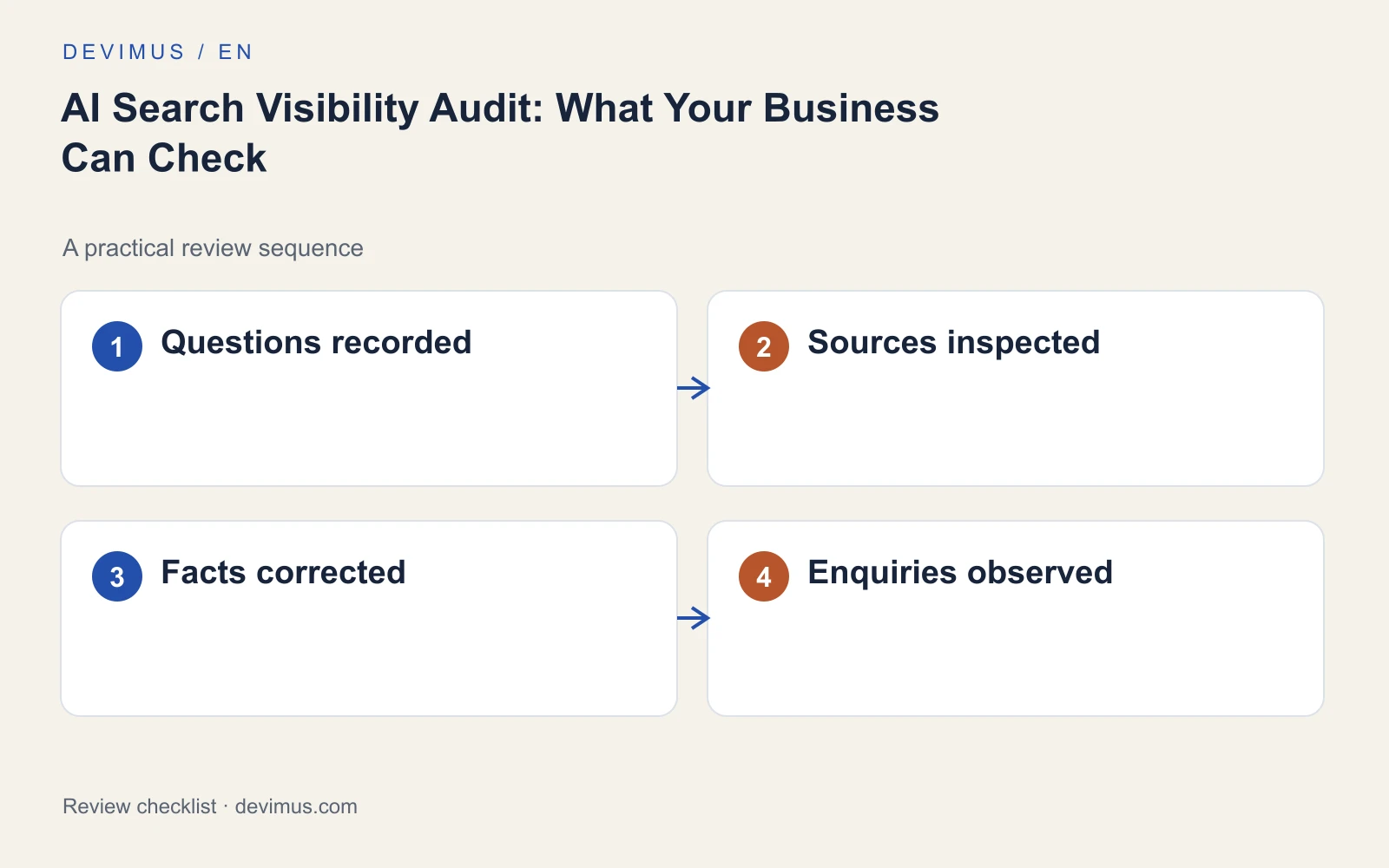
Prioritise the corrections you control
Work through the findings in order of business impact. Incorrect facts come first: address, service area, opening hours, services offered and contact details on your website, Google Business Profile and major directories. Wrong information repeated across several sources is the most likely to reappear in answers.
Next, fix pages that are blocked, slow to render or missing altogether. If customers ask about a service you offer but no page explains it, an AI system has little to cite. Our guide to service page SEO shows how to build pages that answer buying questions clearly.
Then strengthen evidence. Publish what you can substantiate: your methods, project context, qualifications and clear limitations. The principles in our E-E-A-T content guide apply directly, and accurate schema markup can help systems understand who you are. Be wary of anyone who promises that a special file or trick will force inclusion.
How to measure results without overclaiming
Measure what you can observe. In GA4, referral traffic from AI assistants such as ChatGPT or Perplexity can often be identified, and our guide to AI traffic in Google Analytics explains how to set that up. Google states that traffic from its AI features is included in Search Console's Performance report under web search, so it will not appear as a separate source there.
Most importantly, follow enquiries, not mentions. A mention in an answer is not a customer. If your enquiry form asks how people heard about you, add AI assistants as an option. Note any enquiry that says it found you through an AI tool, and review the log alongside your enquiry records each quarter.
An example to apply
Illustrative scenario, not a client case study.
An AI answer says a business serves a city it stopped covering last year. The cited source is an old directory listing, while the business's own service area page was updated months ago.
The fix is to correct the directory listing, check the Business Profile and any other listings for the same error, and record the date of each change in the log. Rechecking later can document whether the answer changed. It does not establish that the edit alone caused the change, and the audit report should say so.
Discuss your project
Give Devimus your key services and the questions prospective clients ask. We will run an AI visibility review with a clear evidence log, source checks and a prioritised list of actions.
Explore the relevant service · Request a free estimate