


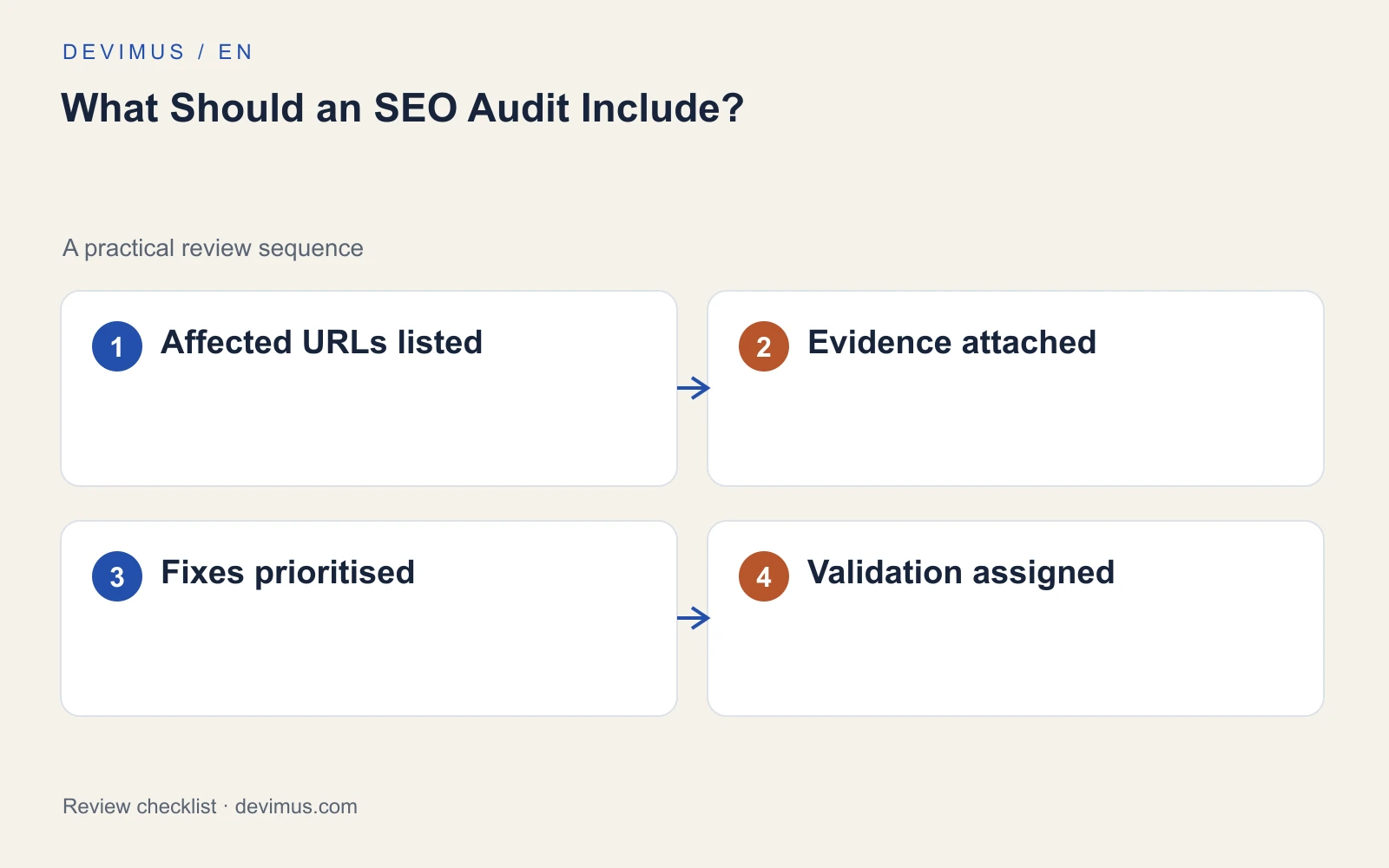
What should an SEO audit include? At minimum: page-level evidence, a prioritised list of fixes, named owners and a way to verify each change. A useful audit is a decision document: it tells your team what is stopping valuable pages from being found or chosen, what to fix first and how to confirm the fix worked. If a report only lists hundreds of automated warnings, you have bought data rather than a plan. Use the checks below before you pay for one.

What areas should an SEO audit cover?
The exact scope depends on your site, but most audits for a service business or small shop should review the areas below. Ask the auditor to confirm which ones are included and which are out of scope.
| Area | What the audit checks | Useful deliverable |
|---|---|---|
| Crawling and indexing | Whether important pages can be found, rendered and indexed | Affected URLs with the cause of each problem |
| Structure and internal links | How service, location and article pages connect | A page inventory showing each page’s purpose |
| On-page content | Titles, headings, duplication and whether pages answer the search | Notes for each priority page |
| Performance and mobile | Loading and responsiveness on key templates | Findings grouped by template |
| Structured data | Whether markup is valid and matches visible content | Errors with recommended corrections |
| Conversion and tracking | Forms, calls and how enquiries are measured | Tracking gaps and a fix list |
Google’s Search Essentials sets out the technical requirements, spam policies and key best practices a site should meet, so it is a sensible reference point for the first two rows. For the performance row, our guide to Core Web Vitals and INP explains which measurements matter and why.
How much of your site should the audit sample?
A small website can often be reviewed page by page, while a large catalogue needs a defensible sampling approach. Ask which page types, languages and customer journeys the audit covers. A good sample includes important commercial pages, recently changed pages and representative templates. Exclusions should be written down, so a report on one section is not mistaken for an assessment of the whole business.
Request a simple inventory that connects each page type to its purpose. A service hub, an individual service page, a location page and an article do different jobs. Include existing redirects, important downloadable documents and pages that still receive relevant visits even if they have dropped out of the main navigation.
What does a useful audit finding look like?
Every important finding should name the affected URLs, the observed problem, its business consequence, the proposed remedy and how the fix will be verified. “Improve metadata” is vague. “These six service pages share one title despite serving different enquiries” is actionable, and it points straight to on-page SEO work your team can schedule.
Keep different kinds of problem apart. Blocked indexing, weak content and a poor route to contact need different people and different fixes. For overlapping pages, the auditor should explain whether they meet distinct needs before recommending consolidation. Crawling tools spot patterns quickly, but the recommendation still needs editorial and business judgement.
Ask which tools and data sources each finding relies on. Search Console shows how Google reports your pages, a crawler shows how the site is linked and analytics shows what visitors actually do. A finding backed by one source is a lead to investigate; a finding confirmed by two is usually ready to act on.
How should audit recommendations be prioritised?
A long list of warnings is not a plan. Ask for severity and effort to be rated separately, because a high-impact problem may need a small correction while a prominent warning may have little commercial consequence. A practical grouping looks like this:
- Critical: issues that stop important pages being crawled, indexed or used, such as an accidental noindex tag or a broken form.
- High value: improvements to pages that already attract relevant searches or should bring in enquiries.
- Clean-up: lower-impact issues that can be batched into routine maintenance.
Each recommendation also needs an owner and its dependencies. A template change may fix many pages at once but require design approval or a release window. A change that needs development time nobody has agreed belongs in the schedule, not on a slide of completed results.
What should the handover and follow-up include?
Agree whether the fee includes implementation, a review call and a follow-up crawl. Before anything changes, record a baseline: your priority landing pages, their search visibility and the quality of enquiries they bring. If you cannot yet see where enquiries come from, set up lead tracking first, or you will have no reliable before-and-after picture.
A follow-up check can confirm that a change is live and that important journeys still work. It cannot by itself prove that a later ranking or revenue change was caused by the fix, so keep implementation checks separate from performance analysis. Also decide who will receive the recommendations and who has time to act on them. If nobody does, a smaller audit with implementation support may be worth more than a comprehensive document. When you compare suppliers on the strength of their audits, our checklist on how to choose an SEO agency covers the questions to ask.
An example to apply
Illustrative scenario, not a client case study.
Suppose an audit flags duplicate titles across twenty pages. Before rewriting all twenty, check whether they represent different services, duplicate URLs or filtered views of the same list. Each cause needs a different remedy: new titles, a redirect or canonical decision, or a change to how filters are handled.
A good deliverable explains that diagnosis, gives a sample fix for one page your team can copy, and says how the change will be checked afterwards. The reasoning matters more than the number of warnings exported.
Discuss your project
Share your website and the services that should generate enquiries. Devimus can scope a technical SEO review around the pages that matter commercially, with a clear handover your team can act on.
Explore the relevant service · Request a free estimate