


SEO vs Google Ads is a timing and economics decision rather than a contest. Google Ads can put you in front of relevant searches as soon as a campaign is live, for as long as you keep paying. SEO improves the pages and visibility that bring people in over time without a per-click cost, but it takes longer to build. Neither fixes an offer people do not want or a contact form that fails. This guide shows how to decide where your budget should go first.

How do SEO and Google Ads differ in practice?
Both channels serve people searching on Google, but they create different commitments. The table below summarises the trade-offs a small business usually faces.
| Factor | Google Ads | SEO |
|---|---|---|
| Speed | Visible once campaigns are approved and running | Builds gradually as pages improve and earn visibility |
| Cost model | Pay per click, plus management time or fees | Pay for work on pages and content, with no per-click cost |
| When spending stops | Ad visibility stops with it | Improved pages keep working, though they need upkeep |
| Control | You choose keywords, areas, schedule and message | You influence relevance and quality, not positions |
| Best suited to | Testing an offer, filling near-term capacity, seasonal pushes | Ongoing demand for core services and building trust |
One point often causes confusion. Paying for ads does not improve your organic position: Google’s guide to how Search works states that it does not accept payment to rank pages higher. Treat the two channels as separate investments, even when they send visitors to the same pages.
Which should come first for your business?
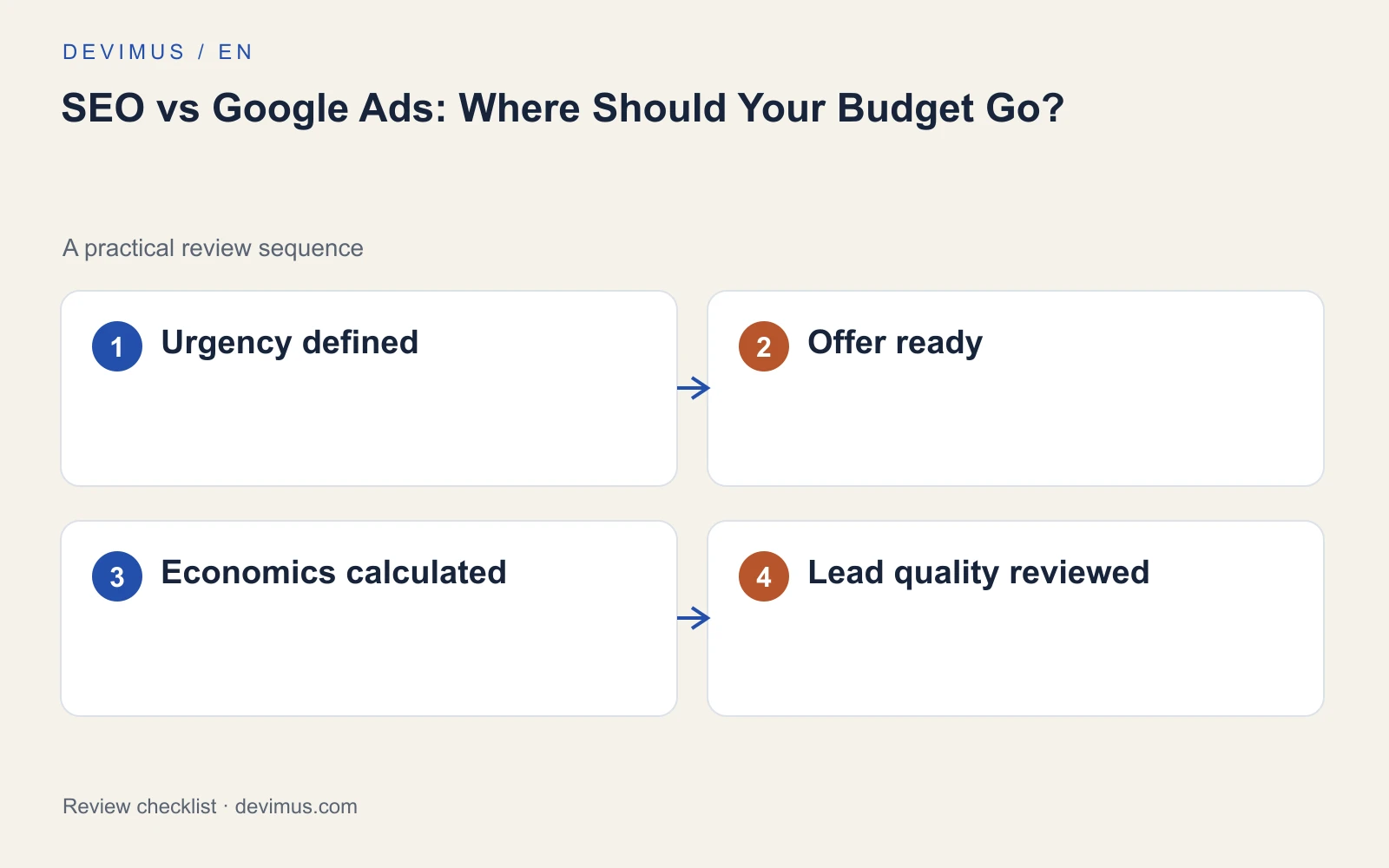
Start with the constraint you are trying to remove. Consider urgency and uncertainty separately: a service that must fill capacity next month needs a different plan from one you have not yet proved you can sell profitably. These signals usually point the way:
- You need enquiries soon for a specific, well-defined service and can respond quickly: a tightly scoped Google Ads campaign is often the faster test.
- You already appear for relevant searches but your service pages are thin or unclear: improving them through SEO may deserve priority.
- Your forms fail, calls go unanswered or the offer is vague: repair that first, because extra traffic from either channel will be wasted.
If you are still testing whether a service is worth selling, committing to a long content programme can be premature. A better service page and reliable measurement, followed by a bounded paid test, is often the more sensible first step.
Check search demand before committing to either channel. If few people search for your service in your area, neither SEO nor search ads will produce much volume, and referrals or other channels may matter more. Keyword Planner in Google Ads and the queries in your Search Console account give a rough picture of how people phrase their searches, which helps you size both options before spending.
How do you set a budget using your own numbers?
Work backwards from what a new customer contributes after the direct cost of delivering the job. Decide how much of that contribution can reasonably go towards winning the customer while leaving room for overheads and profit. Revenue alone can make an expensive channel look attractive when the margin on the work is thin.
In a hypothetical example, a €200 target acquisition cost and a 20% lead-to-client rate allow €40 per lead before other costs. These are planning inputs, not benchmarks. Replace them with your own figures and include management fees and content production. If your closing rate changes, the affordable lead cost changes too, so revisit the model once real enquiries show the quality of demand.
How can SEO and Google Ads support each other?
Paid search terms and sales conversations can reveal questions worth answering on your service pages. Organic pages that already convert well can make good destinations for ads. A question that comes up repeatedly with customers may justify a page improvement even when no report can attribute a sale to that paragraph.
Keep the measurement honest. Record channel costs, landing pages and suitable enquiries separately before looking at the combined picture, and track forms, calls and qualified leads rather than clicks alone. A customer may find you through an ad and return later through organic search, so accept some overlap instead of forcing false precision. If paid enquiries are plentiful but poor, work through the usual causes of weak Google Ads leads before raising spend.
What should you do with a small budget?
Choose the smallest combination that can answer your next business question. That might mean improving one offer page, making sure enquiries arrive reliably and then running a short paid test for that service. Or it might mean pausing ads while you repair a service page that already attracts relevant searches.
Avoid splitting a small budget across every channel at once. Increase investment only when you understand the bottleneck and can fulfil the extra demand, and expand after learning from real customers rather than from forecasts. Write down the question each test should answer and the date you will review it, so the decision does not drift.
An example to apply
Illustrative scenario, not a client case study.
Imagine a contractor with available capacity next month but a website whose enquiry form fails. The first budget decision is a repair. Once enquiries can arrive reliably, a bounded campaign can test demand for the priority service while improvements to the service page support longer-term discovery.
After a few weeks, the contractor reviews which enquiries were suitable and which jobs were won from each route. That evidence decides the next step, whether more ad budget, more page work or both. The sequence matters more than declaring one channel universally superior.
Discuss your project
Give Devimus your priority service, target area, capacity and current lead figures. Request a channel plan tied to a realistic acquisition budget and the measurement needed to review it.
Explore the relevant service · Request a free estimate