


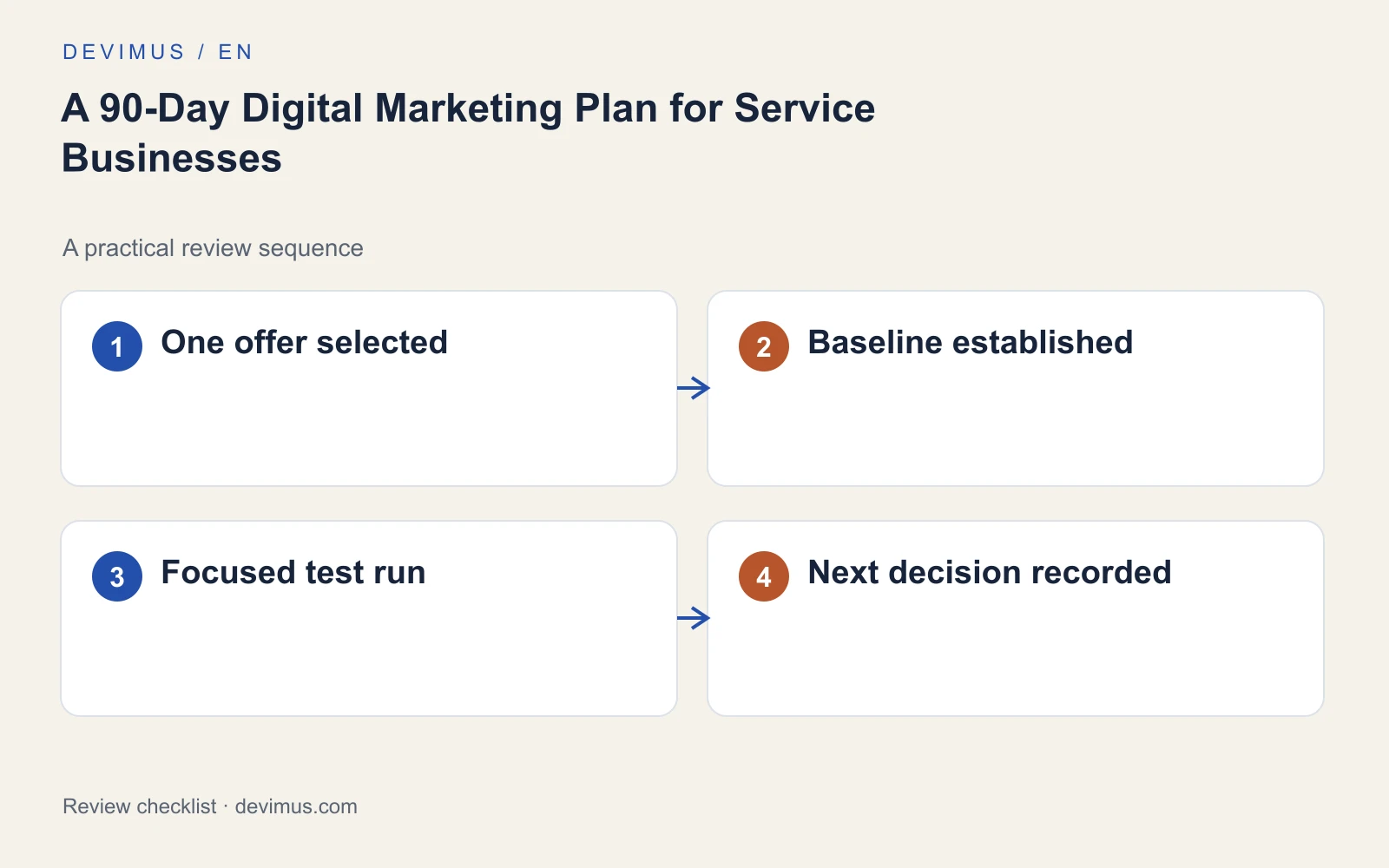
A 90-day digital marketing plan works best when it limits competing priorities. Choose one service, a reachable audience and a clear enquiry outcome, then spend three months establishing a baseline, running a focused test and deciding what to do next from the evidence. The schedule below is a planning framework for service businesses, not a promise of results within three months, and each stage ends with a recorded decision rather than a vague sense of progress.

Before day 1: choose one offer and one outcome
Most marketing plans fail by trying to promote everything at once. Pick the service that has the margin and the capacity to take more work next quarter, and decide what a good result looks like before you spend anything. Answer these questions in writing.
- Which service can you deliver more of without hiring or delaying existing clients?
- Who buys it, and in which areas or sectors?
- What does a suitable enquiry look like in terms of location, job size, timing and budget?
- Who responds to enquiries, and how quickly can they realistically reply?
- What budget and staff time can you commit for 90 days?
The answers become your definition of a qualified lead. Share it with everyone who handles enquiries, so the plan is judged on the same terms by marketing and sales.
Days 1–30: establish the baseline
Review recent enquiries, won work, capacity and the pages that support your chosen service. Count how many suitable enquiries came in over recent months and where they came from, even if the records are rough. That figure is your starting point.
Then test every contact route. Submit the forms, call the phone number from a mobile, check the booking tool and confirm each enquiry reaches the right person. Set up measurement so you can track website forms, calls and qualified leads from day 31 onwards. If you plan to use paid search, set up Google Ads conversion tracking now, not halfway through the test.
Repair obvious gaps in the offer or the service page: missing prices or price factors, unclear areas covered, no proof of past work. Finally, agree the budget, the person who responds to leads and the evidence that will justify continuing, changing or stopping the test.
Agree a short weekly check-in from the start. Fifteen minutes is enough to look at new enquiries, note what changed and flag problems. Without a fixed rhythm, reviews slip and decisions end up being made on impressions at the end of the quarter.
Days 31–60: run a focused test
Improve the main service page so it answers the questions buyers ask before they enquire: scope, process, timescales, what affects price and why they should choose you. Add the supporting content needed to answer those questions in more depth.
If paid acquisition fits your economics, run a bounded Google Ads campaign on the same service, with a fixed budget and a short list of high-intent searches. Our comparison of SEO and Google Ads can help you decide whether paid search belongs in this first test at all.
If most of your work comes from a defined area, check your Google Business Profile in the same month: categories, services, hours and photos. Starting a steady review-request routine costs little and supports both the test and the longer term.
Keep a change log with the date of every page edit, campaign change and pricing update. Review actual enquiries with whoever handles sales at least every two weeks. Avoid launching several unrelated channels at once, because you need to understand both what the business can deliver and what the test is teaching you.
Days 61–90: decide from evidence
Review suitable enquiries, proposals sent, work won and opportunities still open. Account for sales-cycle lag: a quote sent in week ten may not be decided until after day 90. Accept that attribution will be incomplete, especially for calls and repeat visitors.
Then make one of three decisions and record it. Expand what shows credible promise, repair the bottleneck the test has identified, or stop a test that cannot work at an acceptable cost. A simple marketing dashboard that shows where clients come from makes this review faster and less dependent on memory.
Longer-term SEO work may still need time. Google's SEO Starter Guide is clear that changes can take a while to be reflected in search. Distinguish completed improvements from outcomes that have not yet matured, and do not abandon useful work only because the calendar reached day 90.
The plan at a glance
| Phase | Focus | Output at the end |
|---|---|---|
| Before day 1 | One offer, audience and outcome | Written qualified-lead definition |
| Days 1–30 | Baseline, tracking and repairs | Starting figures and a test plan |
| Days 31–60 | One focused test | Change log and reviewed enquiries |
| Days 61–90 | Evidence review | Decision to expand, repair or stop |
Common ways to waste the 90 days include changing several things in the same week, judging results on clicks rather than suitable enquiries, leaving nobody responsible for replying to leads and adding a new channel every time results feel slow. Each one makes the evidence harder to read at the end.
An example to apply
Illustrative scenario, not a client case study.
A service firm finishes its 90 days and finds that suitable enquiries did increase, but many were lost because replies took a day or more while competitors answered within hours.
The next quarter's priority should then be enquiry handling and capacity, such as a shared inbox, a call-back rule and clear quoting templates, rather than simply more traffic. Because the firm had recorded which enquiries came from the tested service page, it also starts the next quarter with a cleaner baseline. A useful plan is allowed to change when the evidence identifies a different constraint.
Discuss your project
Share your priority service, capacity and current marketing activity with Devimus. We will draft a 90-day plan with owners, budget boundaries, tracking and review points you can act on.
Explore the relevant service · Request a free estimate