


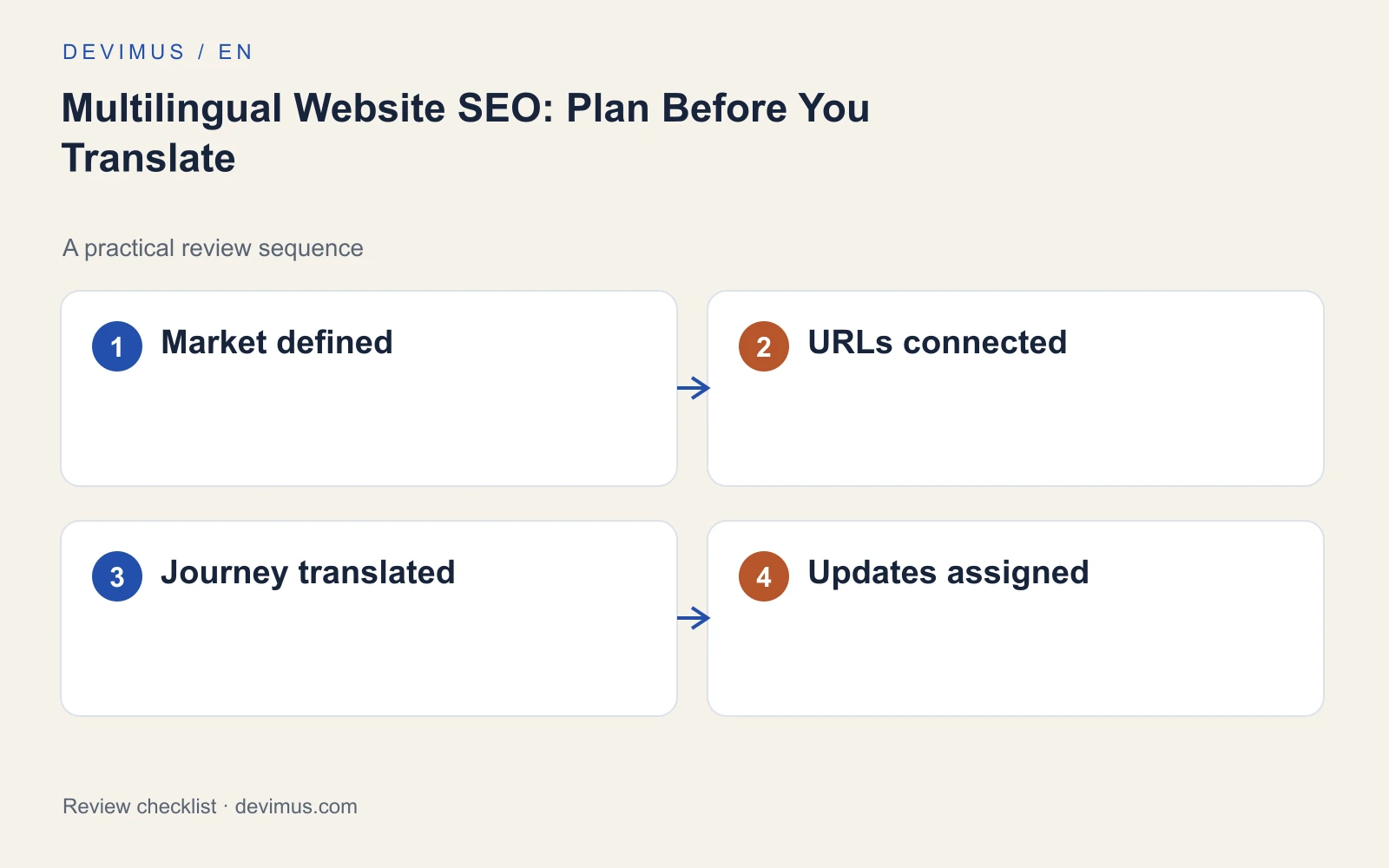
Multilingual website SEO starts before anyone translates a word. Each language version is a new customer journey: it needs its own crawlable URLs, complete service information in the terms local buyers actually search, correct language signals for search engines and an enquiry process your team can handle in that language. Plan the market, structure and maintenance first, and translation becomes the straightforward part. Skip the planning and you end up with mixed-language pages that neither rank well nor convert.

Which languages and markets should you target first?
A language version does not mean you serve every country where that language is spoken. Start from the business: which services can you genuinely deliver to which markets, and who will answer enquiries in each language? If nobody can reply in Italian, an Italian site creates a promise you cannot keep.
Then research how buyers in each market describe the problem. Translating an English keyword literally often misses the terms people really use, and prices, examples and contact expectations may need adapting as well. Native SEO content writing catches differences that a translation tool will not.
How should you structure URLs for a multilingual site?
Give each language its own stable, crawlable URL. The common options are subfolders, subdomains or separate country domains:
| Structure | Example | Typical fit |
|---|---|---|
| Subfolder | example.com/it/ | Most small and mid-sized businesses; one domain to maintain |
| Subdomain | it.example.com | Separate hosting or teams per language |
| Country domain | example.it | Strong focus on one country, with resources to run several sites |
Google explains the trade-offs in its guide to managing multi-regional and multilingual sites. Whichever you choose, avoid serving different languages on the same URL based on cookies or browser settings, because search engines may only ever see one version. Do not automatically redirect visitors by location either; let them choose, and remember the choice.
How do hreflang and canonical tags work together?
Hreflang annotations tell search engines which pages are equivalents in other languages. Each version should list all its alternates, including itself, and every page must link back reciprocally; one-way annotations can be ignored. Use valid language codes, such as it for Italian or sq for Albanian, optionally with a region, and add an x-default for a language selector or fallback page if you have one.
Each language version should carry a self-referencing canonical. Pointing the Italian page’s canonical at the English page tells search engines the Italian page is a duplicate, which undermines the whole hreflang set. Check canonical and hreflang together on representative pages from each template, and confirm every referenced URL returns a working page.
How do you check the setup before and after launch?
Test a sample of pages from every template rather than trusting plug-in or framework settings. For each language, open a service page, an article and the contact page, and confirm that:
- The html lang attribute matches the page language
- Hreflang and canonical tags point to live, indexable URLs
- Each language version appears in the XML sitemap
- Internal links stay within the same language unless the visitor switches
After launch, add the site to Google Search Console and, where useful, a URL-prefix property for each language folder so you can see indexing and queries per language. Watch for pages reported as duplicates where Google chose a different canonical; that usually points to a canonical or hreflang mistake. After a few weeks, review queries by language to see whether your localised wording matches how people really search.
What should you translate beyond the main text?
Translating the homepage while service details, forms and confirmations stay in another language creates a broken experience. Before launch, check that each language covers:
- Page titles, meta descriptions and headings
- Navigation labels, buttons and footer links
- Image alt text and captions
- Form labels, validation errors and confirmation messages
- Automated emails and any PDFs or downloads
- Structured data and contact details for that market
Follow the language switcher from a deep service page: it should lead to the equivalent page where one exists, not drop the visitor on a generic homepage. If there is no equivalent, say so honestly instead of linking to an unrelated page. A CMS set up for multilingual content makes this far easier to maintain; CMS development can add per-language fields and a clear view of what is still missing.
How do you keep language versions aligned over time?
Multilingual sites drift. A new service goes live in English, a price condition changes, an offer is withdrawn, and the other versions quietly fall behind. Keep a translation inventory that maps every page to its equivalents, plus a glossary for service names and recurring terms. Assign an owner who updates all versions whenever the offer changes.
Treat structural changes carefully. Adding or renaming language folders is effectively a migration, so follow a website redesign SEO checklist with redirects and updated hreflang. Then measure enquiries by language with a simple lead tracking setup. A weaker result may reflect limited coverage, missing content or slow replies rather than the translation itself.
An example to apply
Illustrative scenario, not a client case study.
An English service page offers an initial consultation, while its translated button promises an immediate quote. Both phrases sound reasonable, but they set different expectations, and the team receiving the enquiry is caught off guard. Review the promise from headline to form confirmation so each language describes the same next step. Likewise, if a service is available in only one market, do not create a translated page implying identical availability elsewhere; explain the real coverage and link only genuine equivalents.
Discuss your project
Tell Devimus your languages, markets, services and enquiry-handling capacity. We will plan a multilingual setup covering content, URLs, hreflang and ongoing maintenance.
Explore the relevant service · Request a free estimate